As traditional emerging market models crumble, the strategic pivot toward regional industrial security is transforming Latin America into the world’s most critical hedge.
The global map of capital allocation is being redrawn by a force far more potent than mere speculation. We are witnessing a tectonic shift where the old “Emerging Markets” playbook, defined by high-volatility betting on commodities, is being replaced by a sophisticated architectural design known as Optionality. For the modern entrepreneur and institutional investor, Latin America is no longer just a peripheral satellite of the global economy: it has become the central laboratory for a new blueprint of industrial and financial security.
How Latin America Optionality Is Reshaping Global Investment Strategy
This transition matters now because the world has reached a breaking point with extended, fragile supply chains. The premium on proximity has never been higher. As geopolitical friction points multiply across Eurasia, the Western Hemisphere is consolidating. The research is definitive: capital is no longer seeking the cheapest labor, it is seeking the most resilient “optionality.” This is the ability to pivot production, tap into renewable energy grids, and leverage institutional maturity in real-time. Latin America, led by the “Fortress” balance sheets of its private sector, is the only region positioned to offer this three-fold advantage at scale.
Consider the quiet revolution within the industrial corridors of Mexico and the deep tech hubs of Brazil. Companies like Prologis Property Mexico or Brazil’s WEG are not just regional players: they are the new stewards of global supply chain integrity. They represent a class of corporate entity that has survived decades of local political theater to emerge with leaner operations and more robust cash flows than many of their North American peers. This is the human and corporate story of the decade: the rise of the “Anti-Fragile” operator who thrives precisely because they have mastered the art of navigating pressure.
The strategic breakdown for those moving significant capital is focused on the “Physical Transition.” The blueprint requires moving beyond liquid equities and into the specialized infrastructure that makes optionality possible. This means private credit focused on nearshoring logistics, cold-storage real estate that bridges LATAM agriculture with North American tables, and energy infrastructure that powers the data centers of the South. These are the bottleneck assets. By controlling the narrow passes through which global trade must flow, the investor insulates themselves from the macro-volatility that scares off the amateur.
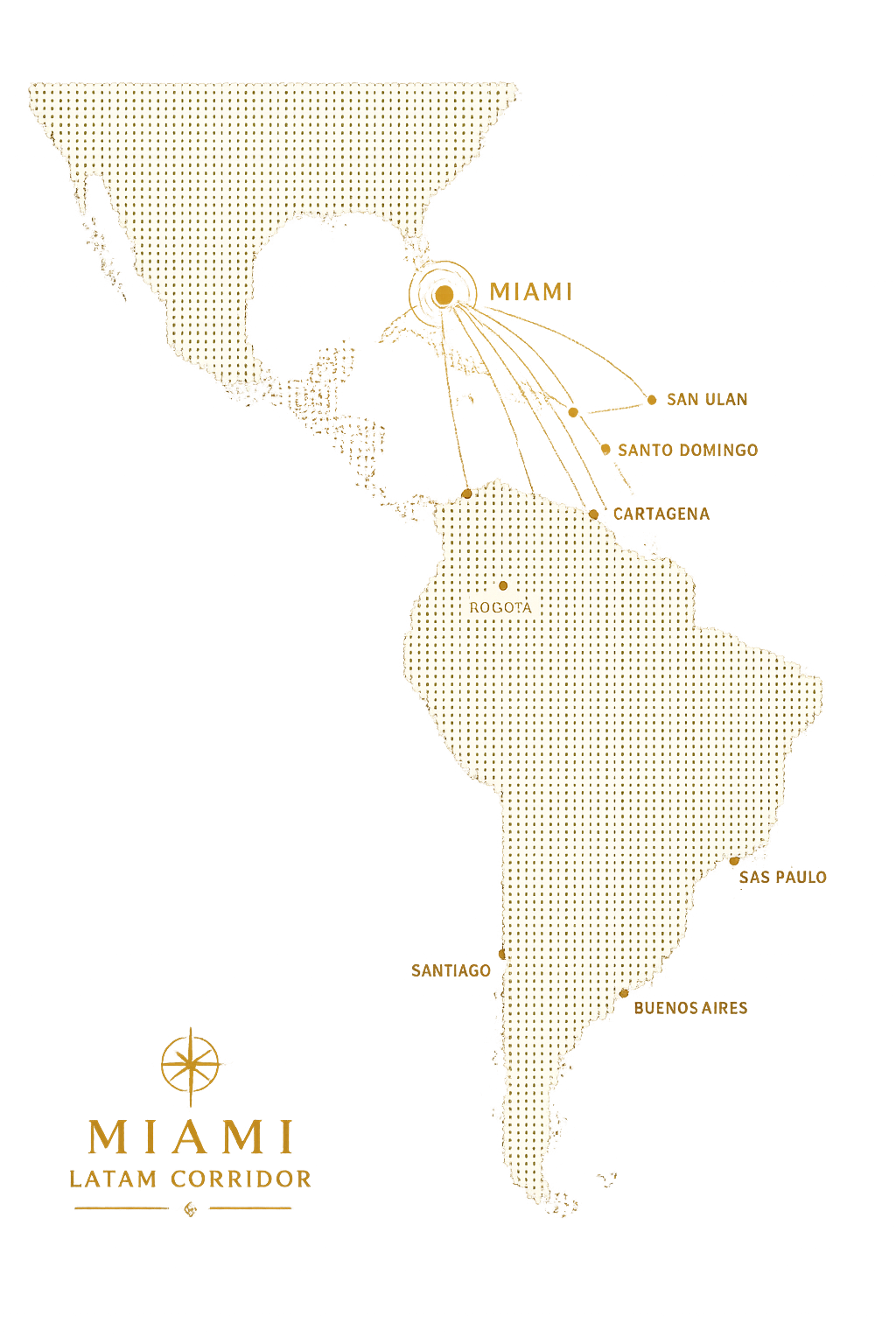
Looking toward 2026, the outlook is one of radical bifurcation. The “Optionality Blueprint” will reward those who recognize that Latin America is the ultimate hedge against a fragmenting world. We anticipate a surge in “Capital-of-LATAM” activity in South Florida, where Miami serves as the de facto clearinghouse for these sophisticated cross-border plays. The risk is no longer the region itself, but the failure to distinguish between the noise of the political cycle and the signal of the structural transformation.
Ultimately, this isn’t about betting on a specific currency or a local election. It is about recognizing that the global economy is entering a period where security is the new growth. Latin America is the bedrock of that security for the Western Hemisphere. The business opportunity of this era belongs to the operators who stop treating the region as a trade and start treating it as the foundation of their global capital strategy.