

Miami Capital Eyes Cuba’s Emerging Private-Sector Corridor

A shift in how critical economic resources enter Cuba may be creating the foundations for future private capital formation tied to South Florida.

MiamiMiami Capital Eyes Cuba's Emerging Private-Sector Corridor

THE SIGNAL

A major fuel shipment from the United States to Cuba’s private sector highlights a broader restructuring of economic access on the island. Rather than flowing through traditional state-controlled channels, critical commercial inputs are increasingly reaching privately operated businesses and market participants.

THE ANGLE

For institutional observers, the important development is the emergence of a parallel economic architecture. Access to fuel, logistics, and commercial activity is becoming more connected to private enterprise networks with external relationships. The result is a gradual reorientation of economic activity toward market-based actors capable of participating in cross-border commerce.

WHY IT MATTERS

Miami has historically functioned as the primary financial gateway between the United States and the Caribbean. As privately operated Cuban businesses gain greater access to commercial resources, demand could expand for trade finance, banking relationships, advisory services, logistics support, and wealth management infrastructure located in South Florida. The opportunity is not immediate market access but the slow construction of a new capital corridor.

WHAT WE’RE WATCHING

  • Growth of private-sector commercial activity inside Cuba
  • Expansion of trade and logistics networks connected to South Florida
  • Development of banking and advisory relationships serving emerging private enterprises
Why Liquidity Has Become the Most Valuable Asset in Private Credit

Private credit's most important shift is not slower growth. It is the growing institutional focus on liquidity management, a change that could reshape how wealth managers, family offices, and allocators approach private markets.

Brazil’s $10 Billion Eco Invest Program and the New Competition for Industrial Capital

Brazil’s $10 billion Eco Invest initiative is attracting global investors into strategic sectors ranging from critical minerals to advanced manufacturing.

The Canal Windfall and the Repricing of Panama Infrastructure

Panama’s canal economy is drawing renewed institutional attention as shipping volatility and supply-chain restructuring increase the strategic value of logistics infrastructure across the Americas.

How David Beckham Built a Billion-Dollar Sports and Branding Empire Through Inter Miami

David Beckham’s billionaire status is not simply a celebrity milestone. It represents the rise of a new economic model where sports ownership, cultural influence, luxury branding, and Miami’s global positioning intersect to create institutional-scale wealth.

Brazil Rates Reinforce Miami Wealth Migration

Brazil’s sovereign debt structure and elevated rates are accelerating long-duration offshore diversification into Miami wealth infrastructure.

Inside Meta’s Louisiana Bet and the New Geography of AI Power

Meta’s massive Louisiana AI facility is more than a technology investment. It represents a new phase of infrastructure capitalism where compute capacity, energy access, and political coordination are becoming strategic economic assets.
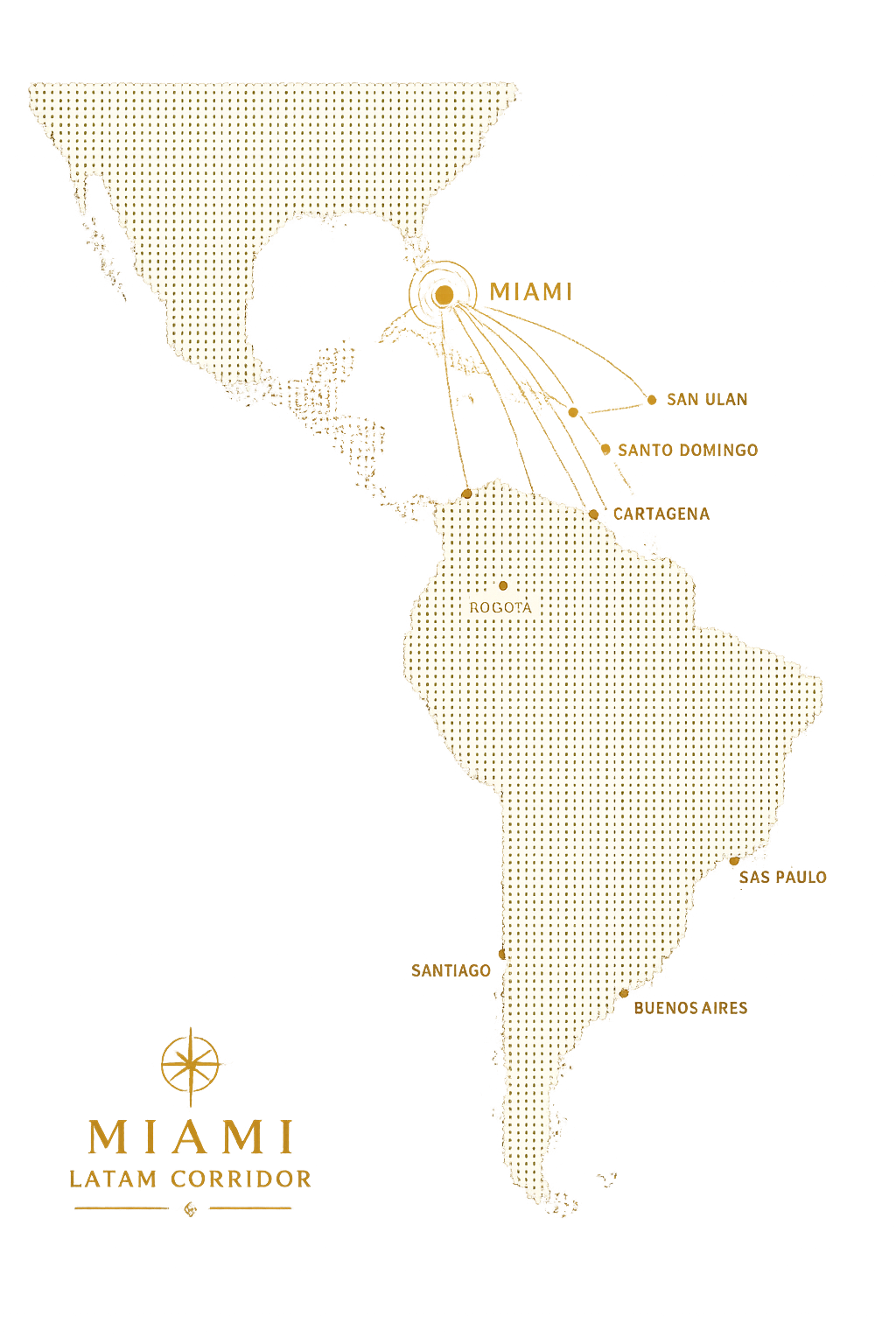
Minimalist gold-tone dotted map of North and South America highlighting the Miami–LATAM corridor with connection lines extending from Miami to major Latin American cities on a soft cream background.

Sign up for our email briefings.