



As Brazil mobilizes foreign capital through state-backed investment structures, the initiative is revealing a broader shift in how governments compete for strategic industries, how institutional investors access emerging-market growth, and how cross-border financial centers position themselves around the deployment of long-duration capital.
Brazil’s latest Eco Invest auction has been framed publicly as a climate-finance initiative. The description is technically accurate, but it obscures the institutional significance of what is being built underneath.
Brazil Rates Reinforce Miami Wealth Migration
The program’s final auction round seeks to mobilize approximately $10 billion of investment through a structure that combines public-sector support with foreign private capital. Officially, the focus spans industrial decarbonization, critical minerals, sustainable fuels, manufacturing modernization, and related sectors. In practice, the initiative reflects a growing preference among governments to influence capital allocation through financial architecture rather than direct ownership.
The distinction matters because it signals a different phase of competition for industrial investment.
Over the past decade, governments largely competed through tax incentives, subsidies, and regulatory concessions. Increasingly, they are competing through capital structures themselves. The objective is no longer simply attracting investment. It is designing frameworks that alter risk-return profiles sufficiently to pull global capital toward strategically important sectors.
Brazil is not alone in pursuing this approach. Similar mechanisms have emerged across Europe, the Gulf states, and parts of Asia. What makes the Brazilian effort notable is the scale of the target and the breadth of industries involved. The initiative arrives at a moment when institutional investors are searching for exposure to real assets, industrial infrastructure, energy-transition supply chains, and strategic commodities without assuming the full risk traditionally associated with emerging-market projects.
For global allocators, the attraction is less ideological than mathematical.
Pension funds, sovereign wealth funds, infrastructure managers, and private-credit platforms continue to face a structural challenge. Many developed markets offer stability but increasingly limited growth. Emerging markets offer growth but often introduce political, regulatory, currency, and execution risks that can complicate long-duration investment mandates.
Programs such as Eco Invest attempt to narrow that gap.
Rather than asking foreign capital to assume all project risk independently, the state becomes a participant in the investment framework itself. Public-sector involvement can absorb portions of downside risk, provide financing support, improve project bankability, or create mechanisms that encourage private participation. The result is a structure that may attract institutions that would otherwise remain on the sidelines.
Viewed through that lens, the initiative appears less like an environmental financing program and more like a capital-attraction strategy designed for a more fragmented global economy.
The sectors receiving attention are revealing. Critical minerals, battery inputs, industrial manufacturing, logistics infrastructure, and energy-transition industries sit at the intersection of multiple strategic priorities. They are important not only for domestic growth but also for supply-chain resilience, resource security, and industrial competitiveness.
Control over these sectors increasingly carries geopolitical implications. Countries that host production capacity, processing infrastructure, and resource reserves occupy more influential positions within global supply chains. Capital directed into these industries therefore serves multiple objectives simultaneously. Economic development, industrial policy, and strategic positioning become increasingly difficult to separate.
That dynamic has become particularly relevant for Brazil.
The country occupies a unique position within the Western Hemisphere. It combines abundant natural resources, significant domestic market scale, growing renewable-energy capacity, and expanding industrial ambitions. At the same time, it continues to seek larger volumes of long-term foreign investment capable of accelerating infrastructure and industrial development.
The Eco Invest structure can be understood as an attempt to reconcile those realities. Rather than relying solely on sovereign borrowing or direct fiscal spending, Brazil is attempting to mobilize external capital while retaining influence over strategic development priorities.
The implications extend well beyond the projects themselves.
Whenever governments create large-scale capital allocation mechanisms, a secondary ecosystem emerges around them. Law firms structure vehicles. Investment banks advise sponsors. Private-credit funds identify financing opportunities. Consultants, insurers, fund administrators, and tax specialists position themselves around anticipated deal flow.
The movement of capital frequently begins with the movement of intermediaries.
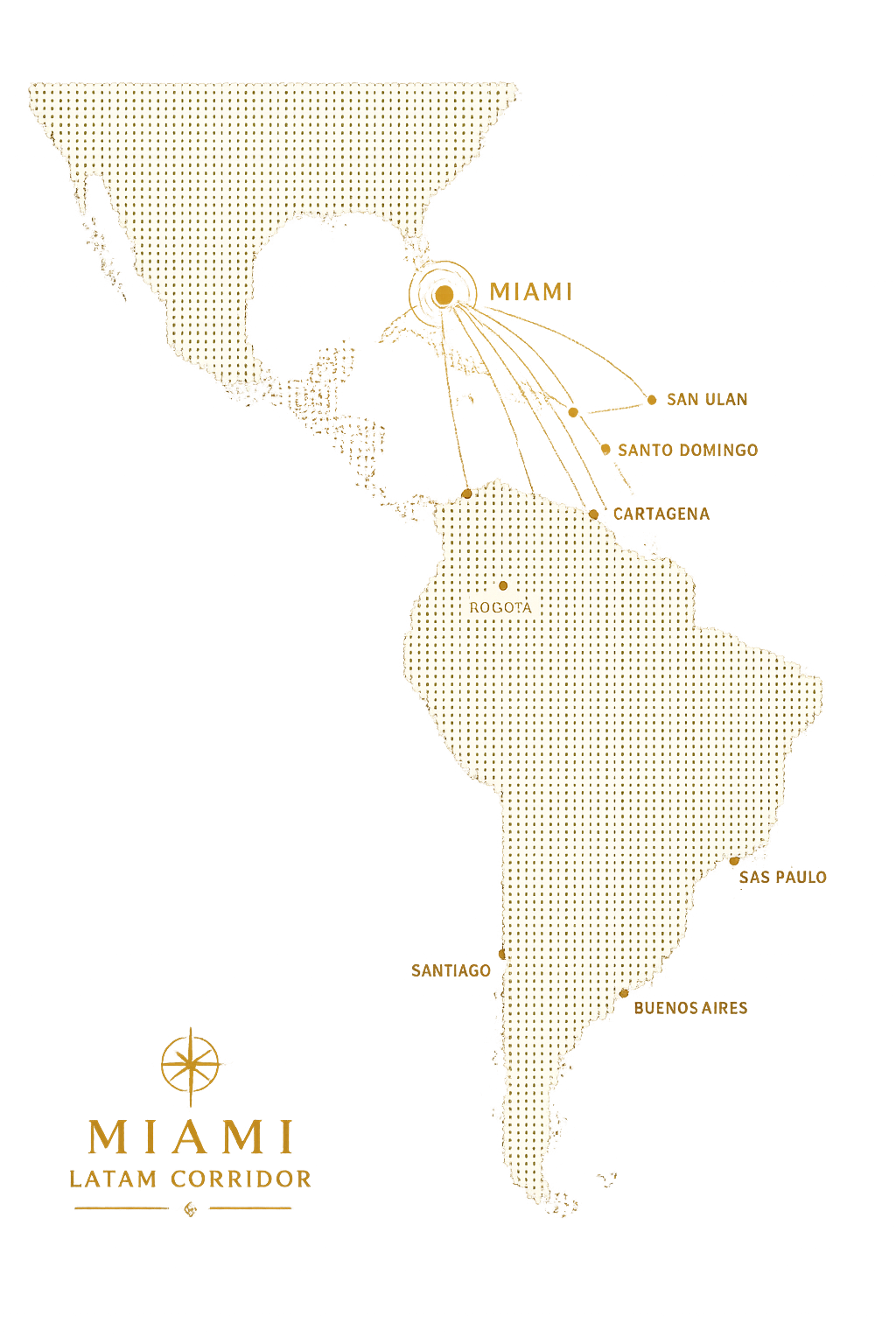
This is where the Miami-Latin America corridor becomes increasingly relevant.
South Florida occupies a distinctive role within hemispheric finance. It functions less as a destination for productive investment and more as a coordination layer connecting investors, operators, advisors, family offices, and financial institutions operating across jurisdictions.
Many Latin American transactions never physically occur in Miami. Yet the legal structures, investment committees, financing discussions, and capital-formation activities often pass through South Florida’s financial ecosystem.
Programs of the scale Brazil is now pursuing tend to activate that ecosystem.
Family offices with regional exposure begin evaluating co-investment opportunities. Infrastructure funds seek local partnerships. Placement agents introduce opportunities to institutional investors. Private banks facilitate relationships between capital providers and project sponsors. Attorneys develop cross-border structures capable of accommodating both foreign investors and domestic operating requirements.
The institutional value generated by these activities can rival the value generated by the projects themselves.
Historically, major investment cycles have often produced parallel growth in financial intermediation centers. The physical assets may be built elsewhere, but advisory, legal, banking, and structuring revenues concentrate in locations capable of connecting capital to opportunity.
Miami’s evolution over the past decade has increasingly reflected this phenomenon.
The city has attracted private wealth, family offices, private banks, investment managers, and specialized legal talent serving Latin American clients. While public attention often focuses on real estate or migration narratives, the more durable development has been the gradual expansion of financial infrastructure supporting cross-border capital flows.
Large investment initiatives originating in Brazil, Mexico, Colombia, and other regional markets increasingly create demand for that infrastructure.
The institutions best positioned to benefit are not necessarily those deploying capital directly into projects. They are often the intermediaries capable of facilitating transactions repeatedly across multiple sectors and jurisdictions.
Another consequence may emerge within private credit.
Infrastructure development, industrial expansion, and energy-transition projects frequently generate financing requirements that extend beyond what public programs initially provide. As project pipelines mature, private lenders often enter alongside equity investors, creating opportunities across senior debt, mezzanine financing, structured credit, and project finance.
Global private-credit managers have already been expanding their presence throughout Latin America. A growing inventory of state-supported projects could further increase institutional appetite for regional lending exposure.
That development would represent a notable shift from previous investment cycles, when emerging-market financing often depended more heavily on traditional banks and development institutions.
The broader environment also favors such structures.
Governments across multiple regions are confronting fiscal constraints. Infrastructure needs remain substantial. Industrial policy ambitions continue expanding. Direct public spending alone is frequently insufficient to meet those objectives.
Capital structures capable of mobilizing private investment therefore become increasingly attractive policy tools.
For investors, the appeal lies in gaining access to sectors viewed as strategically important while potentially benefiting from forms of public-sector participation that reduce risk. For governments, the appeal lies in attracting capital without materially expanding sovereign debt burdens.
Neither side eliminates risk. Political uncertainty, execution challenges, regulatory changes, and commodity-market volatility remain relevant considerations. Yet the willingness of governments and investors to experiment with new financing architectures suggests both recognize that traditional approaches may no longer be sufficient.
The significance of Brazil’s initiative ultimately extends beyond the amount of capital targeted.
The larger story concerns the growing importance of financial engineering as a tool of industrial strategy. Governments are becoming architects of capital formation rather than simply regulators of capital flows. Investors are increasingly evaluating not only assets but also the structures through which those assets are financed. Financial centers are positioning themselves around the resulting networks of intermediation.
As these frameworks proliferate, the competitive landscape may become defined less by where resources exist and more by where capital can be organized efficiently enough to reach them. The institutions paying attention today are not merely assessing individual projects. They are studying the emerging infrastructure of capital itself.