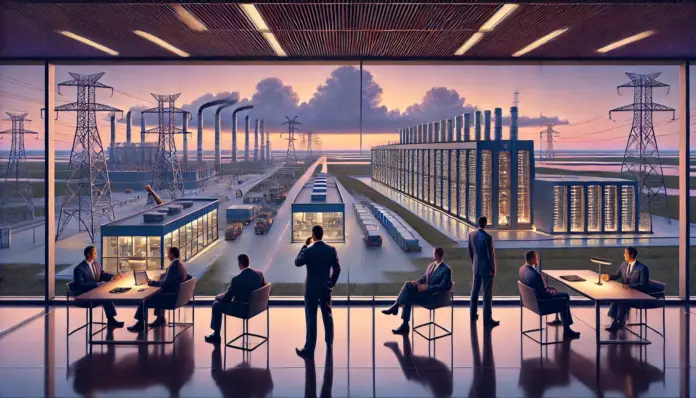
Meta’s decision to anchor one of the world’s largest artificial intelligence facilities in rural Louisiana is not simply a technology expansion story. It is a signal that the AI economy is evolving into a full-scale infrastructure race requiring energy systems, political coordination, private capital engineering, and industrial-scale geographic repositioning.
Bloomberg’s reporting on the company’s projected $200 billion Louisiana data center reveals the extraordinary scale of what major technology firms are now attempting to build. The Richland Parish project could require as much as 7.5 gigawatts of power — including roughly 5 gigawatts dedicated to computing itself — supported by a network of newly constructed natural gas facilities.
That level of energy demand moves artificial intelligence beyond the traditional boundaries of software economics.
The New AI Billionaires and the Infrastructure Economy Behind Them
For most of the modern internet era, digital growth relied primarily on scalable software distribution. AI changes that equation because computational intensity now matters as much as the applications themselves. Large language models require enormous physical infrastructure: chips, transmission systems, cooling networks, power generation, fiber connectivity, water access, and land capable of supporting industrial-scale data operations.
The consequence is that artificial intelligence is beginning to resemble a heavy industrial sector as much as a software sector.
Meta’s Louisiana investment reflects that shift clearly. The company is no longer simply competing for users or advertising revenue. It is competing for computational dominance. That changes how corporations allocate capital, how states compete for investment, and how infrastructure itself is valued by markets.
The economics surrounding these facilities increasingly resemble strategic industrial projects rather than conventional technology campuses. Bloomberg described the financing behind the Louisiana development as one of the largest private capital arrangements ever assembled for a data infrastructure project.
That matters because the AI race is rapidly becoming constrained by physical bottlenecks rather than software innovation alone.
Access to semiconductors is limited.
Grid capacity is constrained.
Power generation takes years to expand.
Transmission infrastructure faces regulatory delays.
Suitable land with energy access is increasingly scarce.
As those constraints tighten, the value of geographic positioning rises dramatically.
That partially explains why corporations are increasingly moving AI infrastructure into regions previously considered peripheral to the technology economy. Rural Louisiana offers land scale, political alignment, lower regulatory friction, energy availability, and economic incentives difficult to replicate in more saturated technology corridors.
The project also reveals how aggressively state governments are now competing for AI infrastructure investment. Louisiana’s leadership reportedly committed extensive tax incentives and economic development support to secure the facility.
This resembles earlier industrial eras more than the venture-backed software cycles of the last decade.
States are effectively competing to become strategic compute territories.
That shift carries long-term implications for labor markets, utility systems, industrial development, and regional political influence. Large AI facilities create secondary economic ecosystems around them: construction networks, engineering firms, energy contractors, logistics systems, industrial suppliers, private financing structures, and real estate development corridors.
The infrastructure supporting AI increasingly behaves like the infrastructure supporting ports, refineries, or transportation hubs.
Energy is becoming central to this transformation.
The Louisiana facility’s dependence on newly constructed natural gas plants reflects a growing reality inside the AI economy: computational expansion is fundamentally an energy expansion story.
For years, markets treated data growth as relatively abstract and weightless. Artificial intelligence is reintroducing physical intensity into the digital economy. Every increase in computational scale produces corresponding pressure on electrical grids, cooling systems, and industrial power generation.
That dynamic is already reshaping adjacent sectors. Utilities, pipeline operators, power producers, and infrastructure financiers are increasingly being revalued through the lens of AI demand growth. Analysts now speak about “AI electricity demand” the way earlier industrial cycles discussed steel demand or oil consumption.
This also helps explain the growing convergence between technology companies and energy infrastructure providers. The relationship is becoming structurally inseparable.
The implications extend well beyond Louisiana.
The broader AI infrastructure buildout is beginning to reorganize capital geography across the United States. Secondary regions with available land, favorable regulation, and expandable energy systems are becoming increasingly important within the emerging compute economy.
At the same time, financial hubs capable of intermediating the wealth generated by this infrastructure expansion are likely to gain influence. South Florida’s role fits into this dynamic differently than Louisiana’s. Miami is unlikely to become a hyperscale compute center itself, but it continues strengthening its position as a private capital coordination hub connected to technology wealth, Latin American investment flows, and institutional asset management.
As AI infrastructure spending accelerates, secondary systems expand around it: private equity funds, infrastructure financing vehicles, family office allocations, tax planning networks, and cross-border investment structures. South Florida increasingly sits adjacent to those flows.
That relationship matters particularly as Latin American investors seek greater exposure to U.S. digital infrastructure and AI-adjacent assets. Institutional capital from the region has shown growing interest in energy systems, logistics infrastructure, data centers, and private technology financing rather than purely speculative software exposure.
The Louisiana project also reflects a subtle but important evolution in corporate strategy itself.
Technology firms are no longer operating purely as software companies. Increasingly, they resemble hybrid industrial utilities controlling vertically integrated systems spanning semiconductors, energy procurement, compute infrastructure, cloud ecosystems, and AI deployment networks.
The market may still describe this as a technology cycle, but the underlying economics increasingly resemble industrial capitalism adapted for the computational era.
That distinction matters because infrastructure cycles tend to produce deeper concentrations of long-term power than application cycles. Consumer technologies can change quickly. Infrastructure dependency compounds slowly and durably.
Meta’s wager on Louisiana is ultimately a wager that artificial intelligence will become foundational enough to justify industrial-scale investment measured not in millions, but in energy grids, regional economies, and generational capital commitments.
And if that assumption proves correct, the next decade may not simply be defined by who builds the best AI models.
It may be defined by who controls the infrastructure civilization increasingly depends on.