

The Canal Windfall and the Repricing of Panama Infrastructure

As global trade routes face mounting geopolitical pressure, Panama is regaining strategic importance across logistics, trade finance, and cross-border infrastructure investment tied to the Miami-LATAM corridor.

Real Estate CapitalThe Canal Windfall and the Repricing of Panama Infrastructure

Rising geopolitical pressure across traditional maritime routes, combined with LNG shipping demand and supply-chain fragmentation, has renewed institutional focus on the Panama Canal as a hemispheric logistics control point. Shipping operators and infrastructure allocators are increasingly rerouting freight exposure through Panama as reliability becomes more valuable than pure efficiency.

The implications extend beyond canal traffic. Panama’s surrounding ecosystem — trade finance, warehousing, maritime insurance, free-trade zones, and logistics-linked real estate — is beginning to absorb secondary capital inflows tied to long-duration supply-chain restructuring. The corridor between Miami and Panama is also deepening as financial coordination, legal structuring, and trade intermediation increasingly operate as an integrated cross-border system.

Institutional capital appears less focused on short-term shipping volume than on ownership and control of infrastructure layers benefiting from geopolitical fragmentation. Logistics parks, bonded industrial assets, maritime services, and trade-adjacent financing platforms are quietly becoming strategic accumulation targets across the region.

The canal’s renewed importance reflects a broader shift in global capital behavior. Infrastructure capable of monetizing instability is increasingly attracting long-duration institutional conviction.
Why Liquidity Has Become the Most Valuable Asset in Private Credit

Private credit's most important shift is not slower growth. It is the growing institutional focus on liquidity management, a change that could reshape how wealth managers, family offices, and allocators approach private markets.

Miami Capital Eyes Cuba’s Emerging Private-Sector Corridor

The real signal is not energy supply. It is the gradual creation of a privately intermediated economic corridor that could reshape future capital formation, banking relationships, and commercial activity between Cuba and Miami.

Brazil’s $10 Billion Eco Invest Program and the New Competition for Industrial Capital

Brazil’s $10 billion Eco Invest initiative is attracting global investors into strategic sectors ranging from critical minerals to advanced manufacturing.

How David Beckham Built a Billion-Dollar Sports and Branding Empire Through Inter Miami

David Beckham’s billionaire status is not simply a celebrity milestone. It represents the rise of a new economic model where sports ownership, cultural influence, luxury branding, and Miami’s global positioning intersect to create institutional-scale wealth.

Brazil Rates Reinforce Miami Wealth Migration

Brazil’s sovereign debt structure and elevated rates are accelerating long-duration offshore diversification into Miami wealth infrastructure.

Inside Meta’s Louisiana Bet and the New Geography of AI Power

Meta’s massive Louisiana AI facility is more than a technology investment. It represents a new phase of infrastructure capitalism where compute capacity, energy access, and political coordination are becoming strategic economic assets.
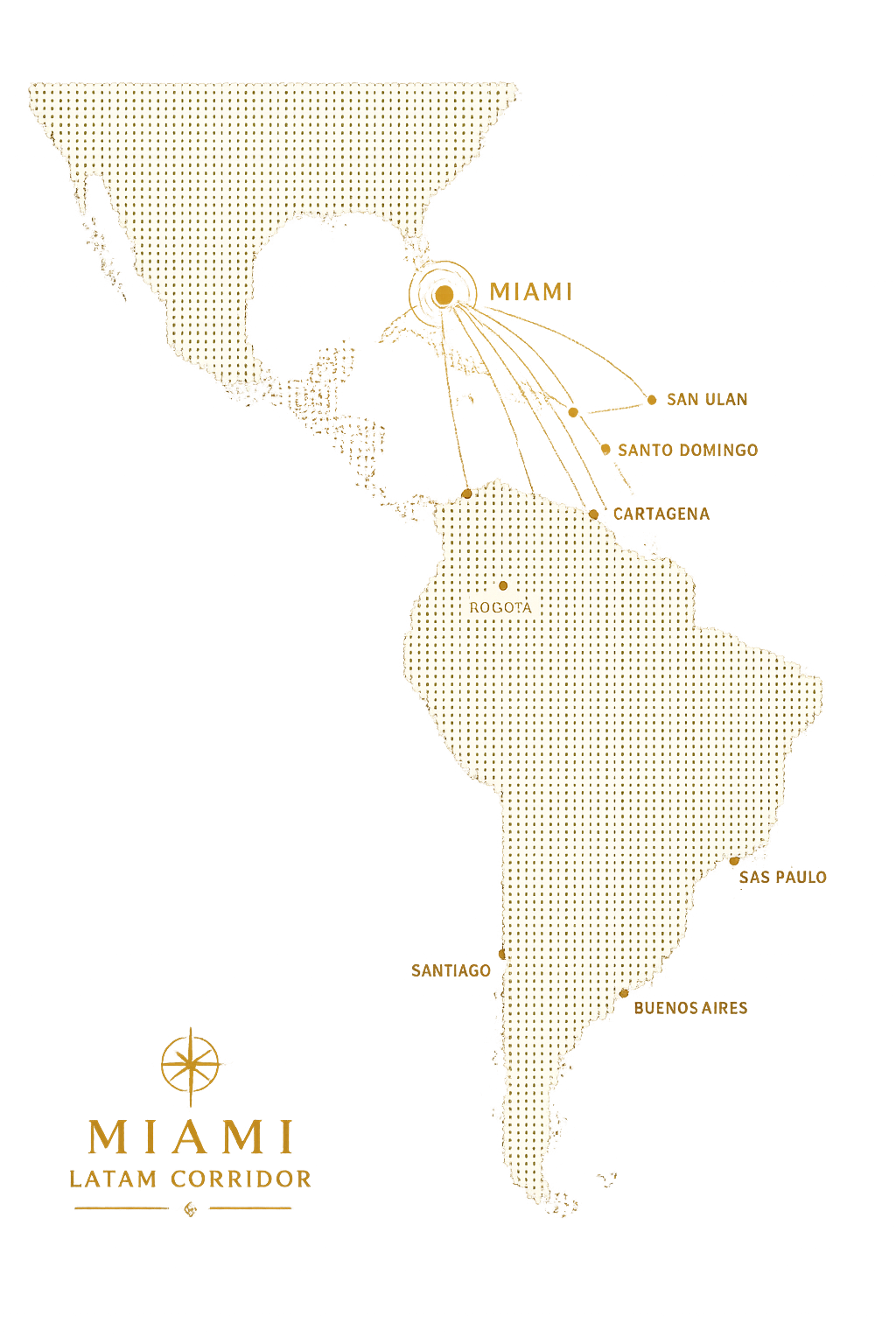
Minimalist gold-tone dotted map of North and South America highlighting the Miami–LATAM corridor with connection lines extending from Miami to major Latin American cities on a soft cream background.

Sign up for our email briefings.