
For decades, Latin America has been the market investors talked about with hesitation. Rich in resources, full of promise, and consistently unable to convert that promise into sustained economic dominance. That narrative is now being challenged, not because the region has suddenly solved its structural issues, but because the world has changed around it.What is unfolding in 2026 is not a Latin American transformation. It is a global repricing of what Latin America represents.
The shift begins with something simple but powerful. The world now needs what Latin America already has.
Critical minerals tied to electrification. Agricultural capacity tied to food security. Energy production tied to geopolitical realignment. Latin America sits at the intersection of all three. The region holds a significant share of global reserves in copper, lithium, and agricultural exports, placing it in a position few regions can replicate .
But this time, the demand is different.
Globalization is no longer about efficiency alone. It is about resilience, alignment, and control. Supply chains are being restructured, not optimized. Companies and governments are prioritizing proximity, political alignment, and reliability over pure cost advantage. That shift is pulling Latin America into a more central role in global trade and production.
At the same time, internal dynamics are evolving. Political cycles across the region are showing signs of movement toward more pragmatic leadership. Voters, fatigued by instability and economic underperformance, are increasingly prioritizing security, growth, and institutional stability. This does not eliminate risk, but it introduces a different kind of political backdrop, one that markets tend to reward .
Yet the reality remains complex.
Economic growth across the region is still uneven. Forecasts for 2026 suggest moderate expansion, with structural inefficiencies and fiscal pressures continuing to limit acceleration . Latin America remains a region of divergence, not uniform progress.
This is where the concept of optionality becomes critical.
Investors are not approaching Latin America as a certainty. They are approaching it as a strategic option.
Optionality means exposure without full commitment. It allows capital to participate in upside scenarios while maintaining flexibility if risks materialize. In practical terms, this translates into selective investment in sectors tied to global demand, rather than broad based allocation across entire economies.
Energy projects. Mining operations. Agricultural infrastructure. Digital financial systems. These are the areas attracting attention, not because they eliminate risk, but because they align with global necessity.
For entrepreneurs and operators, this shift changes the rules.
Access to capital will increasingly depend on alignment with global trends rather than local narratives. Businesses tied to export capacity, resource efficiency, and technological integration will find themselves in a stronger position. Those operating in purely domestic, structurally constrained sectors may find capital harder to access.
For investors, the lesson is even sharper.
Latin America is no longer a binary decision between risk and reward. It is a portfolio tool. A way to gain exposure to macro themes such as energy transition, food demand, and supply chain restructuring without direct dependence on developed markets.
This is where South Florida enters the equation.
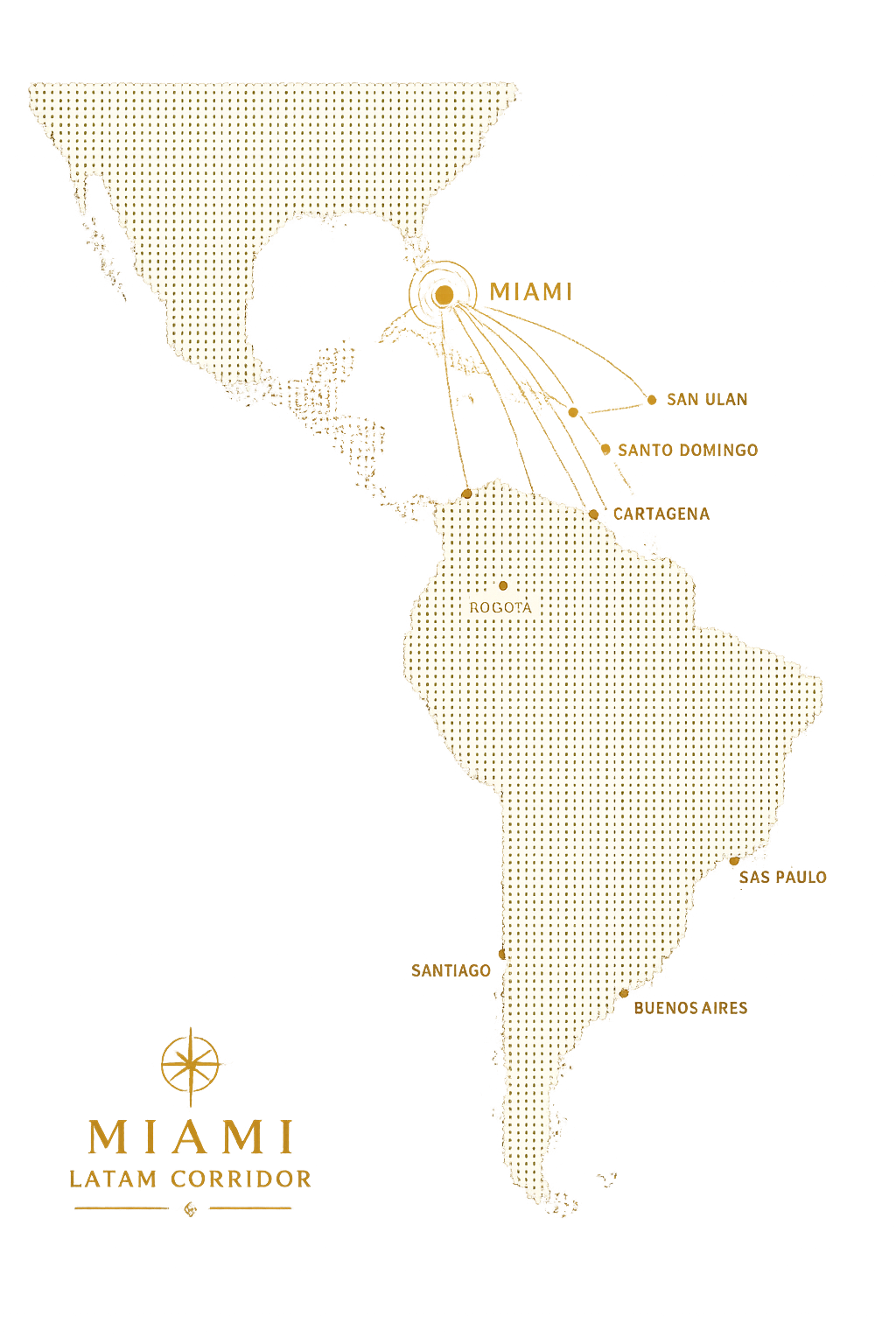
Miami is not just a geographic bridge. It is a capital hub. Wealth from across Latin America flows into South Florida for stability, while investment capital flows outward into the region in search of opportunity. As Latin America becomes more strategically relevant, Miami’s role as an intermediary becomes more valuable.
The city is not benefiting from growth alone. It is benefiting from positioning.
Looking ahead, the opportunity is real, but it is conditional.
Latin America’s advantage lies in its resources, demographics, and geographic positioning. Its constraint lies in execution. Policy consistency, fiscal discipline, and institutional strength will determine whether this cycle becomes transformative or simply another missed opportunity.
The difference this time is that the world is paying attention.
And when global capital starts paying attention to a region it once ignored, the upside is not guaranteed, but the optionality becomes valuable.