

John DeLorean never blended in, even when blending in would have saved him.
By the late 1960s, General Motors had already handed him what most executives spend a lifetime chasing. He was young, visible, and credited with reshaping Pontiac into something faster, louder, and culturally relevant. The GTO wasn’t just a car. It was proof that DeLorean understood something Detroit didn’t like to admit out loud. Desire mattered more than decorum. Speed mattered more than hierarchy. Identity sold better than obedience.
Inside GM, this made him dangerous.
He dressed differently. He spoke differently. He walked factory floors like he didn’t need permission. While other executives followed the script, DeLorean rewrote it in real time, smiling while he did it. He was promoted anyway. Success has a way of muting discomfort. By 1973, he was the youngest division head in the company’s history, overseeing Chevrolet, the crown jewel.
And still, it wasn’t enough.
Detroit rewarded scale, not distinction. Stability, not deviation. DeLorean understood that power inside a system is always conditional. The moment your ambition outgrows the structure, the structure reminds you who it belongs to.
So he left.
Walking away from General Motors wasn’t framed as rebellion at the time. It was pitched as vision. A new American car company. A cleaner future. Ethical manufacturing. Innovation without compromise. DeLorean Motor Company was announced with language that sounded responsible and modern, but underneath it was something more personal. This wasn’t about cars. This was about control.
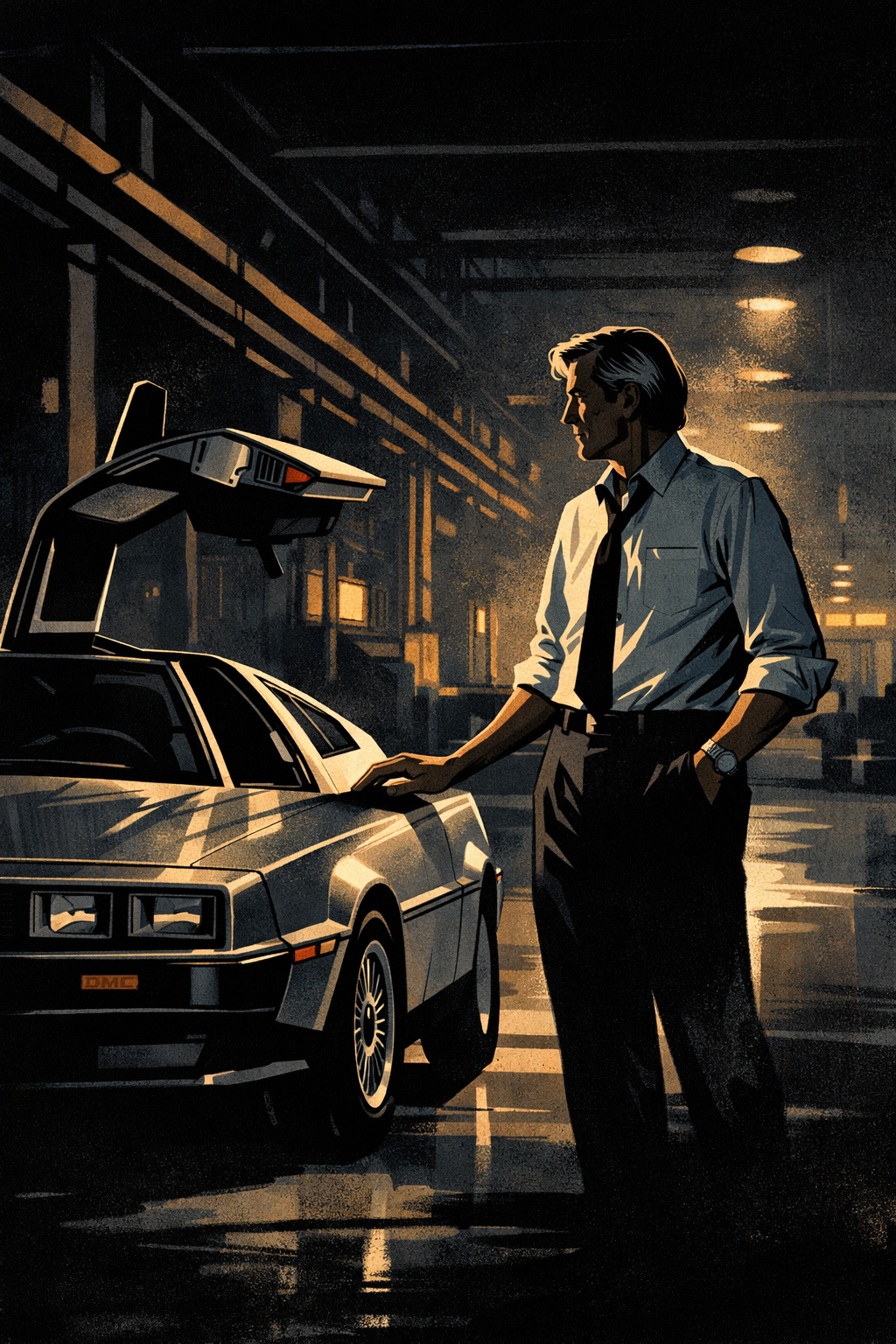
The DMC-12, with its stainless steel body and gull-wing doors, was a physical rejection of conformity. It didn’t look like Detroit. It didn’t sound like Detroit. It didn’t behave like Detroit. DeLorean didn’t just want to build a car. He wanted to reposition himself outside the gravitational pull of institutions that had already decided what was acceptable.
The problem wasn’t the idea. It was the velocity.
Factories don’t forgive impatience. Governments don’t forgive misalignment. Capital doesn’t forgive visibility without containment.
Northern Ireland offered incentives. The British government offered financing. Jobs were promised. Optics mattered. The factory rose quickly, too quickly, in Dunmurry, just outside Belfast, at a time when political tension made every decision heavier than it looked on paper. The workforce was inexperienced. The supply chain fragile. The timelines unforgiving.
Momentum arrived before the foundation settled.
Production delays stacked quietly at first. Quality issues followed. Costs ballooned. The stainless steel panels that made the car iconic made it expensive and difficult to adjust. The very features that made the DMC-12 unmistakable also made it inflexible. DeLorean was no longer fighting Detroit. He was fighting physics, finance, and patience.
This is where leadership stops being cinematic.
Because real power isn’t tested at launch. It’s tested in the months after applause fades, when decisions compound without witnesses. DeLorean stayed visible. He traveled. He reassured. He projected confidence because confidence had always worked before. But capital behaves differently outside systems that absorb mistakes.
By 1982, the company was bleeding. British funding froze. Production halted. The spotlight narrowed. And then came the moment that would permanently reframe DeLorean’s legacy. The FBI sting operation. The cocaine charges. The image of the man who once redefined American automotive ambition now framed through a grainy lens of scandal.
He was acquitted. Legally cleared. But reputation doesn’t operate under the same rules as courts.
Leadership stories usually end with redemption or collapse. DeLorean’s ended with ambiguity, which is harder to metabolize. He didn’t fail because he lacked intelligence or vision. He failed because his ambition outran his containment. He stood apart before the structure around him could support isolation.
This is the part most empresario narratives skip.
Standing out is intoxicating. Being distinct feels like progress. Visibility feels like leverage. But leadership isn’t about how far you can step away from the system. It’s about how quietly you can reposition without destabilizing everything beneath you.
DeLorean never learned to disappear between moves. He stayed public while recalibrating. He stayed loud while the ground shifted. And when momentum turns against you, noise accelerates the fall.
Years later, the DeLorean would become a cultural artifact, immortalized not by its commercial success but by its symbolism. A time machine in a movie about changing outcomes. A perfect irony. The car that represented futurism became a nostalgia object. The man who wanted independence became defined by the moment control slipped.
Every empresario eventually reaches this phase. When effort has worked. When distinction has paid off. When visibility becomes exposure instead of advantage. The decision isn’t whether to keep moving. It’s whether to change posture.
DeLorean never repositioned quietly. He believed motion itself would protect him. It didn’t.
Leadership doesn’t fail loudly at first. It erodes privately. In factories after midnight. In funding meetings that stall. In pauses that last too long. The moment arrives not as collapse, but as recognition. Something has outgrown its environment.
John DeLorean saw the future clearly. What he underestimated was how much patience it demands.