
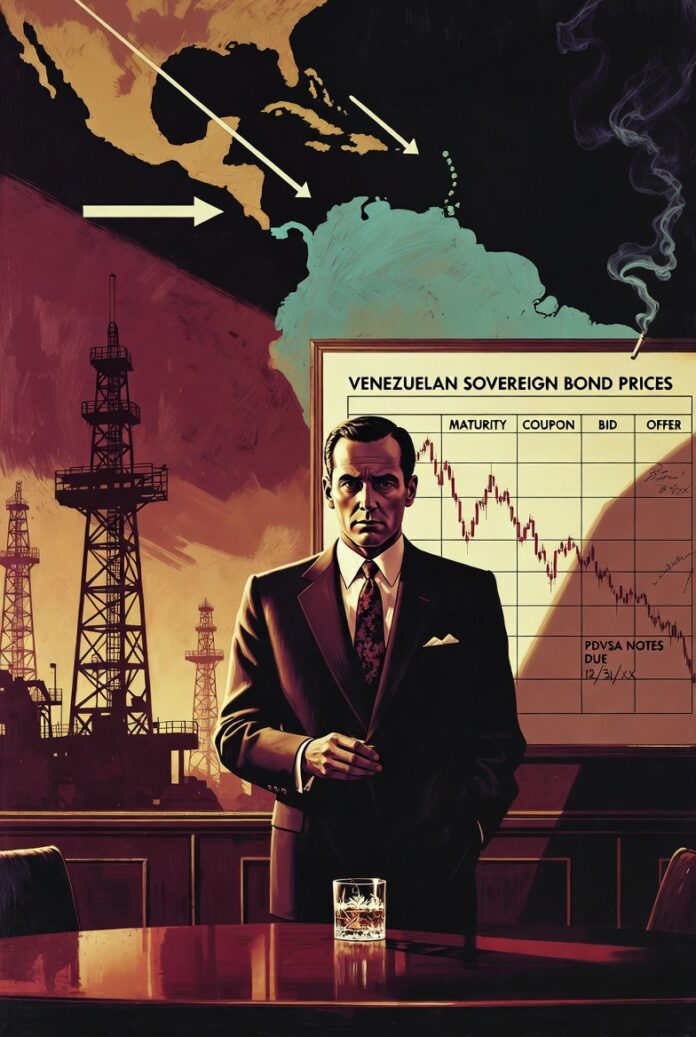
Venezuelan sovereign bonds tumbled on Monday, June 22, 2026, hitting their lowest levels in two months as investors positioned ahead of a major forthcoming review of the country’s debt burden and economic prospects. Sovereign notes fell across the curve, with the benchmark 2027 bonds dropping below 50 cents on the dollar for the first time since April 10. Bonds issued by state oil company Petróleos de Venezuela SA (PDVSA) also declined in tandem.
The sell-off reflects caution among holders of Venezuela’s roughly $60 billion in defaulted sovereign and PDVSA bonds (part of a broader $150–170 billion external debt stock) as a formal debt assessment process advances. This comes amid ongoing expectations around potential restructuring following earlier political shifts and renewed interest in Venezuelan oil assets. The review will scrutinize repayment capacity, economic recovery potential, and the viability of any future debt workout.
THE SIGNAL Capital is de-risking Venezuelan distressed debt exposure in advance of a formal sovereign debt assessment that could reset recovery values and restructuring terms for both sovereign and PDVSA obligations.
THE ANGLE Most observers frame this as another episode in Venezuela’s chronic instability and bond market volatility. In reality, the price action reveals institutional capital carefully calibrating exposure ahead of a high-stakes infrastructure event: the formal assessment of debt sustainability and economic prospects that will shape any eventual restructuring.
Bondholders who had ridden earlier rallies on regime-change optimism and oil reopening narratives are now locking in caution. The drop below key technical levels (50 cents on 2027s) signals that sophisticated players are unwilling to hold through uncertainty around how the assessment will treat different creditor classes, oil revenue pledges, and PDVSA’s operational liabilities. This is not blanket rejection of Venezuelan assets but a classic pre-restructuring repositioning where capital waits for clearer signals on recovery waterfalls and new money requirements before committing further.
WHY IT MATTERS FOR MIAMI–LATAM Miami serves as the primary hub for much of the Venezuelan diaspora wealth, family offices, and private banking relationships tied to Latin American capital. A disciplined debt assessment and potential restructuring process directly affects the valuation and liquidity of Venezuelan paper held in Miami-based portfolios, impacting wealth preservation strategies and cross-border flows between South Florida and Caracas/Maracaibo networks.
For Latin American family offices and private banks with regional exposure, this highlights the importance of infrastructure around distressed sovereign and quasi-sovereign debt in high-volatility corridors. Successful (or failed) restructuring mechanics could influence capital allocation appetites toward other LATAM distressed opportunities and set precedents for how private banking channels intermediate recovery capital or new oil-linked financing. It reinforces Miami’s role as the command center for pricing and distributing LATAM risk.
WHAT WE’RE WATCHING
- Outcome and creditor positioning in the formal debt assessment/review process.
- Any shifts in PDVSA operational or collateral treatment that could unlock or restrict new capital inflows.
- Institutional reallocation flows between Venezuelan exposure and other LATAM high-yield or distressed assets.