
SIGNAL ORIGIN
Reported by: Reporter not identified in accessible source.
Publication: The Economist
Original headline: Paraguay’s swaggering digital bank has fallenDate: November 5, 2026
Signal Type: Original Reporting
STORY
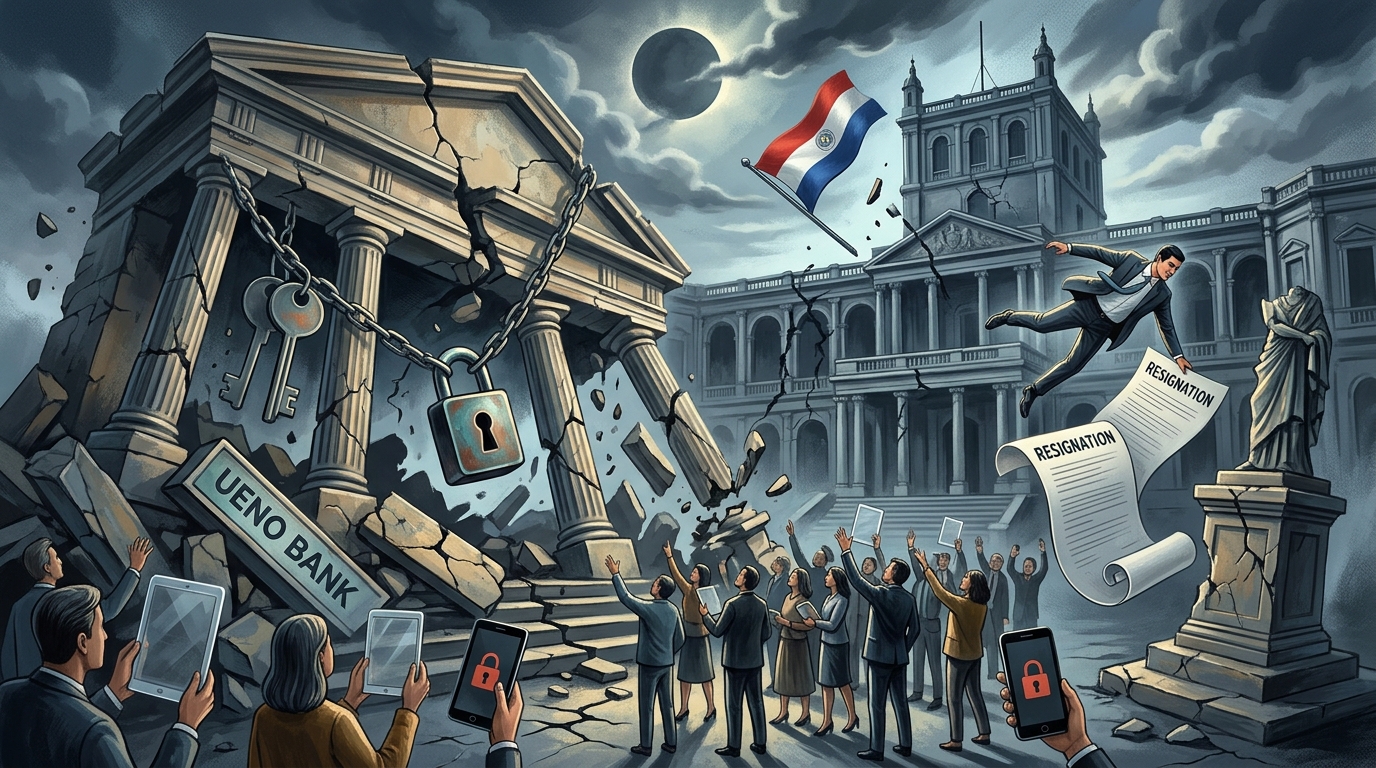
Paraguay’s central bank initiated resolution proceedings for Ueno Bank, freezing operations for the digital lender that served three million depositors—over 60% of the nation’s adult population. Regulators intervened after financial statement adjustments revealed Ueno’s solvency ratio fell to 5.56%, less than half the 12% legal minimum, driven by improperly documented related-party lending to companies linked to controlling shareholder Grupo Vázquez. Ueno also held roughly $800 million in public deposits, including state pension funds. The resulting account freeze triggered widespread financial disruption and mounting political fallout, culminating in President Santiago Peña announcing his resignation amid scrutiny over his historical business ties to Grupo Vázquez. Eight senior executives face arrest alongside formal charges against 27 officials.
SIGNAL
The Central Bank of Paraguay has taken over digital lender Ueno Bank following severe capital degradation stemming from related-party exposure, locking out three million account holders and triggering the resignation of President Santiago Peña.
CAPITAL ANGLE
The collapse of Ueno Bank highlights a structural mismatch in Latin American fintech expansion: rapid user acquisition backed by consumer incentives can mask fragile balance-sheet capital structures and inadequate governance. Ueno captured a dominant retail footprint—banking over 60% of Paraguay’s adult populace in under five years—while masking severe capital shortfalls through unverified assets and concentrated credit exposure to entities tied to its parent conglomerate, Grupo Vázquez.
For institutional investors and cross-border financial entities operating across the Americas, the event reveals how rapid digital scale does not substitute for robust credit underwriting and capital adequacy standards. Furthermore, the concentration of state pension reserves and public funds within an aggressively expanding neo-lender illustrates how weak regulatory perimeter enforcement can create systemic contagion, converting institution-level governance failures into broader sovereign macro risk.
WHAT WE’RE WATCHING
- The regulatory resolution process and asset migration structured by Paraguay’s central bank to restore retail depositor liquidity and transfer active accounts.
- Legislative actions and executive succession in Paraguay following President Santiago Peña’s resignation announcement.
- Tightened regulatory oversight and stricter enforcement of related-party lending limits across digital banking platforms in Latin America.