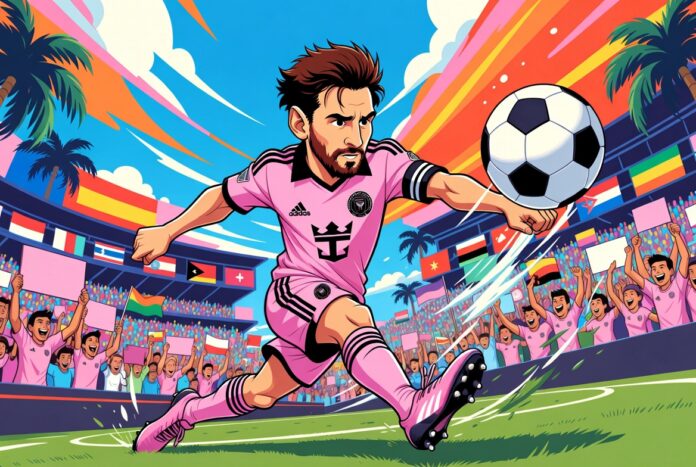
Lionel Messi is no longer just the face of Inter Miami or Major League Soccer. He has become a financial infrastructure asset tied directly to the economic positioning of South Florida ahead of the 2026 FIFA World Cup.
The 2026 tournament will be remembered as the moment the United States fully institutionalized global football economics, but the center of gravity inside that transition is increasingly concentrated in Miami. Messi’s arrival accelerated a structural transformation already underway across tourism, real estate, media rights, hospitality, sovereign branding, and international capital migration. What began as a sports acquisition has evolved into one of the most successful economic repositioning strategies in modern American sports history.
The importance of Messi entering the 2026 World Cup while playing professionally in Miami extends far beyond ticket sales or television ratings. His presence creates a convergence between global football audiences and US financial infrastructure at the exact moment FIFA is attempting to permanently expand its commercial footprint across North America.
That convergence matters because global sports are no longer simply entertainment properties. They are economic ecosystems capable of redirecting tourism flows, foreign investment, real estate demand, media valuation, and sovereign influence. Football in particular functions as one of the few truly borderless cultural and commercial systems capable of mobilizing billions of dollars across continents simultaneously.
Miami sits directly at the center of that system.
Since Messi joined Inter Miami in 2023, the club’s valuation has surged from roughly $585 million to an estimated $1.45 billion while the broader South Florida economy experienced measurable increases in tourism demand, hospitality revenue, retail activity, and international visibility.
The scale of that transformation explains why Messi’s influence can no longer be measured through sports metrics alone. He operates more like a sovereign level economic catalyst whose presence compresses years of international branding development into a much shorter cycle.
That acceleration becomes even more important entering the 2026 World Cup because Miami is uniquely positioned inside the tournament’s financial geography. Unlike other host cities whose relevance will rise temporarily during the event itself, Miami already functions as an established international capital corridor connecting North America, Latin America, and Europe.
Messi strengthens that corridor because he carries institutional trust across all three regions simultaneously.
For Latin American audiences, Messi represents cultural legitimacy and emotional gravity unmatched by nearly any modern athlete. For American investors and developers, he represents scalable global monetization. For FIFA, broadcasters, sponsors, and multinational brands, he represents the most commercially efficient gateway into expanding football’s economic dominance within the United States.
Why Latin American Optionality is the New Blueprint for Global Capital
How Miami Became the Capital Command Center for Latin American Wealth
That combination turns Miami into more than a host city. It turns the region into a long term football capital infrastructure platform.
The construction of the approximately $1 billion Miami Freedom Park project reflects this shift clearly. The stadium development is not simply a sports venue investment. It represents a larger urban economic repositioning strategy built around tourism density, entertainment spending, hospitality expansion, retail monetization, and international event hosting capacity.
Large sporting infrastructure projects historically struggle when they depend exclusively on local demand. Messi changes that equation because he globalizes demand itself. Fans do not travel to Miami solely for Inter Miami matches. They travel for access to a globally recognized football economy centered around his presence.
That distinction dramatically changes the economics surrounding sponsorships, hotel occupancy, premium real estate development, aviation traffic, luxury retail, and international broadcasting rights.
It also changes how institutional capital evaluates South Florida.
The World Cup arrives during a period where Miami is already absorbing increasing levels of international wealth migration tied to Latin American political instability, European tax pressure, remote capital mobility, and global demand for dollar denominated assets. Sports infrastructure now reinforces that migration pattern by strengthening Miami’s identity as a permanent international gateway city rather than a seasonal tourism market.
Messi’s role inside this process is unusually strategic because he compresses audience acquisition costs for every institution attached to the football ecosystem. Sponsors gain immediate global visibility. Hospitality operators gain predictable tourism inflows. Media companies gain international engagement. Developers gain international branding leverage. FIFA gains credibility inside the US market. MLS gains legitimacy it spent decades struggling to achieve organically.
Very few athletes in history have operated as multipliers across so many sectors simultaneously.
The broader implication for the 2026 World Cup is that the tournament may ultimately produce more lasting economic value for Miami than for many traditional football markets. South Florida already possesses the international airports, multilingual workforce, hospitality infrastructure, financial connectivity, and cultural alignment necessary to absorb long term football commercialization beyond the tournament itself.
Messi acts as the bridge that accelerated those systems into alignment before the World Cup even began.
That influence will likely shape the tournament atmosphere itself. Argentina matches involving Messi are expected to produce some of the highest demand profiles across the competition, with host cities already anticipating significant economic upside tied directly to his participation.
Yet the larger effect may occur after the final match is played.
The United States has historically struggled to convert temporary football enthusiasm into durable domestic economic structures. Messi may change that because his tenure in Miami normalized elite football consumption inside American business culture before the World Cup arrived. Corporate sponsorships expanded. MLS valuations climbed. Stadium financing accelerated. International partnerships increased. Football shifted from niche entertainment to institutional asset class.
Inter Miami itself became evidence of that transformation. Messi’s compensation package reportedly ranges between $70 million and $80 million annually once equity participation and commercial arrangements are included, numbers that would have been nearly unthinkable for an MLS franchise a decade earlier.
That financial structure reveals the deeper reality beneath the spectacle. Messi was never simply a player acquisition. He was a long duration capital allocation decision designed to reposition Miami and Major League Soccer within the hierarchy of global sports commerce.
The 2026 World Cup will amplify that strategy onto the largest stage in international sports.
By the time the tournament concludes, Miami may no longer be viewed primarily as an emerging football market. It may instead be recognized as the financial and cultural headquarters of football’s expansion into the Americas, with Messi remembered not just as the greatest player of his generation, but as the catalyst who accelerated that transformation into reality.