There is a strange irony unfolding in New York right now. For decades, politicians promised to “tax the rich” while quietly hoping the rich would stay exactly where they were. The slogans were useful during campaigns. The outrage energized voters. The billionaires, meanwhile, kept funding buildings, offices, charities, restaurants, and entire tax bases large enough to keep the machine running.
But Zohran Mamdani appears willing to test something previous generations of New York politicians only flirted with.
What happens when wealthy people finally decide they are no longer wanted?
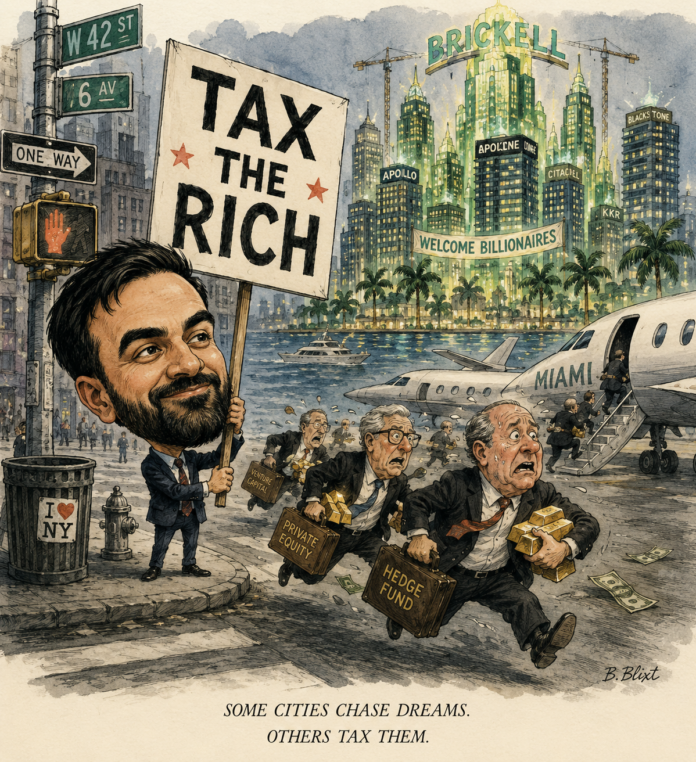
That question now sits at the center of a growing panic among business leaders after Mamdani intensified his public attacks on billionaires, including a highly publicized campaign video filmed outside hedge fund billionaire Ken Griffin’s Manhattan residence. Griffin responded sharply, warning that Citadel may continue expanding in Miami instead of New York, fueling fears that another wave of elite capital could accelerate southward.
On the surface, this story looks political.
Underneath, it is entirely about capital behavior.
That distinction matters because capital rarely moves emotionally. It moves strategically.
And right now, America’s highest earners are increasingly behaving like global investors managing geopolitical exposure rather than loyal residents emotionally attached to a single city.
New York is discovering that wealthy individuals no longer need legacy financial capitals the way they once did. Technology, remote dealmaking, distributed teams, and mobile infrastructure have broken geography’s monopoly on power. The old assumption was simple: if you wanted access to finance, prestige, and institutional influence, you had to tolerate New York’s costs, taxes, and politics.
That leverage is evaporating.
Miami changed the equation.
What began as a pandemic relocation trend has matured into something much more serious. South Florida is no longer functioning as a tax refuge. It is becoming an operational headquarters for modern wealth.
That difference is enormous.
Vacation homes do not permanently alter economies. Headquarters do.
When firms like Citadel build massive long term infrastructure in Miami, they are not buying beachfront toys. They are repositioning the future geography of American finance. Law firms follow. Private banking follows. Venture capital follows. Luxury development follows. Political influence follows.
Entire ecosystems migrate alongside capital.
And the timing could not be worse for New York.
Cities like New York, Chicago, San Francisco, and Los Angeles are entering a dangerous phase where political rhetoric increasingly collides with fiscal dependency. The wealthiest taxpayers fund a disproportionate percentage of urban budgets. Simultaneously, those same taxpayers are now the most geographically mobile people in the country.
That creates a fragile equation.
The harder politicians lean into anti wealthy populism, the more they risk accelerating the exact tax flight they claim will never happen.
Mamdani’s rhetoric may energize parts of the electorate, but elite capital interprets these moments differently. Billionaires and large operators are not hearing “fair taxation.” They are hearing instability, hostility, and future escalation.
Once that perception sets in, relocation conversations begin quietly behind closed doors.
And they are already happening.
The most sophisticated wealth managers in America are no longer asking whether clients should diversify geographically. They are asking how quickly they can do it before policy risk intensifies further.
This is one reason Miami feels increasingly inevitable.
Florida offers more than tax advantages. Plenty of places have low taxes. Miami offers psychological alignment. That phrase sounds abstract until you understand how wealthy individuals actually think.
Successful entrepreneurs, investors, and operators want to build inside environments where achievement is culturally rewarded rather than politically demonized. They want governments that compete for capital instead of threatening it. They want predictability.
Miami understands this intuitively.
New York increasingly appears conflicted about it.
That perception alone changes investment flows.
There is another layer here that deserves more attention, especially from South Florida business leaders.
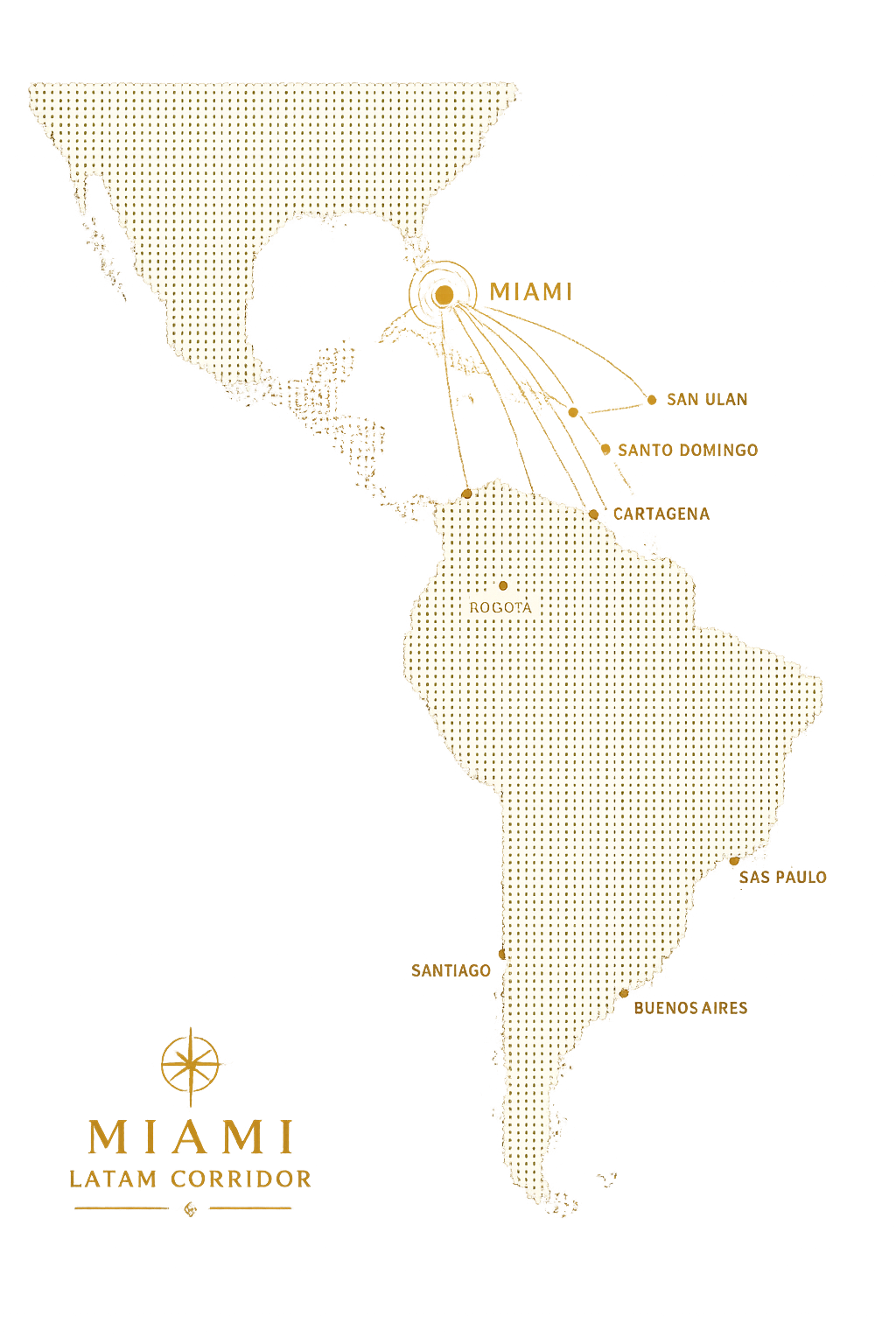
Latin American capital has a completely different relationship with political risk than most American commentators understand. Wealthy families from Venezuela, Argentina, Brazil, Colombia, and Mexico have decades of experience watching governments weaponize resentment against productive classes during moments of fiscal pressure.
How Miami Became the Capital Command Center for Latin American Wealth
To many international investors, New York’s political tone feels less shocking than familiar, and when wealthy people begin hearing familiar warning signs, they start building optionality.
Optionality is becoming one of the defining themes of modern wealth strategy.
The smart money is no longer concentrating itself entirely inside one jurisdiction, one political structure, or one tax environment. It is diversifying operational exposure the same way investors diversify portfolios.
That means dual headquarters. Multiple residences. Distributed teams. International banking relationships. Florida trusts. Strategic relocation planning.
The entrepreneurs winning this cycle are not necessarily the smartest people in the room.
They are the most adaptable.
Critics, of course, insist wealthy individuals always threaten to leave and rarely follow through. Some online reactions mocked the idea entirely, arguing New York’s cultural gravity remains too powerful for any meaningful exodus.
But this misunderstands how economic decline actually begins.
The danger is not that every billionaire disappears tomorrow morning.
The danger is where future expansion no longer happens.
Where does the next hedge fund open offices?
Where does the next family office relocate?
Where are future jobs created?
Where does the next generation of founders choose to scale?
That is where cities either rise or slowly decay.
And increasingly, the answer points toward South Florida.
Miami’s emergence is not accidental. It is the result of decades of strategic positioning colliding with a moment when legacy cities appear uncertain about their relationship with wealth creation itself.
In many ways, Mamdani may become an accidental mascot for Miami’s next economic boom.
Because every time New York treats capital like an enemy, Florida quietly turns itself into the escape route.
And capital, unlike politics, rarely waits around to argue.