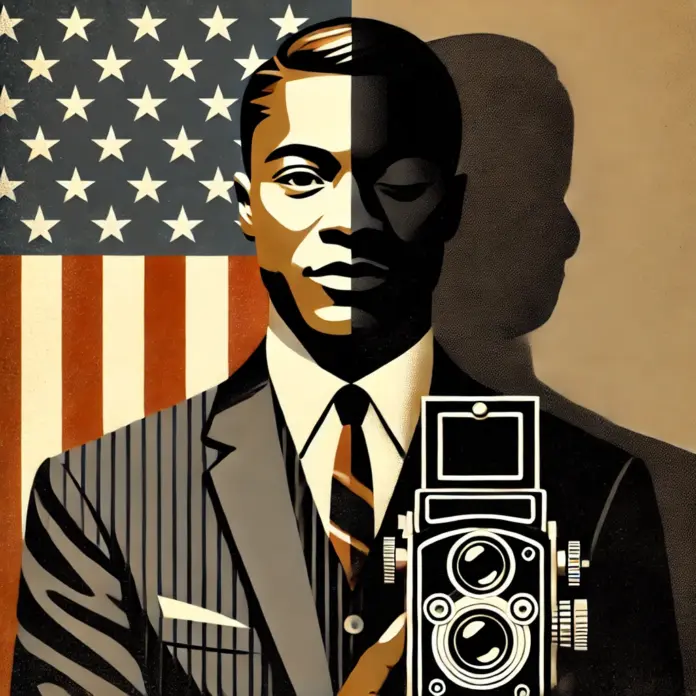
He carried a camera the way some men carry a conscience — heavy, deliberate, always within reach. Gordon Parks moved through America’s shadowed rooms with the steady grace of someone who had learned early that the world was divided by lines only a lens could cross. Light and dark. Wealth and poverty. Power and those denied it. In the mid-century hush of segregated streets, he discovered a truth that would define him: a camera was not a machine. It was a key.
He arrived in Washington, D.C., the way ambition often does — quietly, without an entourage, carrying little more than hunger and the stubborn spark of a man who refused to stay unseen. The capital brimmed with polished marble and official smiles, but Parks walked through it as an outsider, studying the space between the frames the way an architect studies shadows. He was not yet famous. He was not yet respected. But he was already awake.
America in those years loved its myths clean and uncomplicated. Gordon Parks sought their cracks.
His first assignments for the Farm Security Administration were small, forgettable on paper — the kind of jobs given to the newcomer who didn’t yet command a room. But Parks didn’t document life. He revealed it. In a single click, he could turn a janitor into a philosopher, a child into a witness, a kitchen into a cathedral. His photographs didn’t ask for permission. They asked for accountability.
It was there, behind the lens, that he discovered his philosophy of identity: people were not defined by circumstance but by the dignity they carried in the quiet spaces of their lives. That was where he focused his attention — the quiet, the ordinary, the overlooked. And in doing so, he made the invisible visible.
He became a visual insurgent.
To walk with Gordon Parks was to see the world differently. He noticed the shadows first — how they curved around a staircase, clung to the edges of a doorway, or stretched across a bus seat like an unwelcome reminder. He stood in those shadows as if they were part of him, as if he understood that truth reveals itself not in brightness, but in contrast. His camera didn’t hunt beauty; it hunted honesty.
The day he photographed Ella Watson — the cleaning woman posed with her broom and mop before the American flag — Parks didn’t stage a portrait. He staged a confrontation. “American Gothic,” he called it. A borrowed title with a sharpened edge. Washington recoiled. The country blinked. Parks had pulled back the curtain on a nation desperate to appear whole.
From that moment on, his mission crystallized: use art as power.
As his fame grew, he moved from poverty-stricken alleys to the glittering salons of New York, from Harlem stoops to Hollywood sets. He was the first Black staff photographer at Life magazine, the first to direct a major Hollywood film, the first to navigate the spaces America had declared off-limits. But he walked through those spaces without flinching, camera swinging against his chest like a medal he never asked to wear.
His ego was quiet but undefeated. Critics whispered that he was too bold, too ambitious, too comfortable stepping into worlds that weren’t built for him. But Parks understood something essential: identity is not granted. It is claimed.
Even at glamorous premieres, he remained half in shadow, studying the light the way a strategist studies terrain. He saw past the silk gowns and the polished speeches, fixing his eye instead on the hesitation in a gesture, the vulnerability beneath a smile. Truth, he believed, was always hiding in plain sight — if you were willing to look long enough.
Late at night, in his Manhattan apartment above the soft hum of taxis, Parks would spread his photographs across a long table. Some were harsh. Some tender. All were necessary. He didn’t see them as trophies. He saw them as testimony — proof that a nation was more complicated, more wounded, more extraordinary than it ever admitted.
His turning point came not from acclaim, but from clarity: he wasn’t documenting America. He was decoding it.
Identity, he realized, is a negotiation between how the world sees you and how you see yourself. His work existed in that negotiation — the tension, the ache, the resilience. Every shutter click was a declaration: I see you. I see the truth. I see the America you carry.
Every Empresario learns eventually that power is not always loud. Sometimes it is captured in silence — in the curve of a hand, the weight of a stare, the shadow beneath a streetlight. Gordon Parks understood that silence intimately. He turned it into a language.
And long after the lights dimmed on the studios he conquered and the magazines he transformed, the legacy remained — not in galleries or awards, but in the faces he honored and the truths he refused to soften. His camera carved a path not just for himself, but for every artist who believed that storytelling was a form of justice.
In the end, Gordon Parks did not simply take photographs.
He offered America a mirror.
And dared it to look.

Louie Molina is the host and architect of The Empresario. Drawing from years of financial design and strategic consulting, he created The Empresario Reserve as the ultimate repositioning strategy — a system that turns financial instruments into instruments of control.