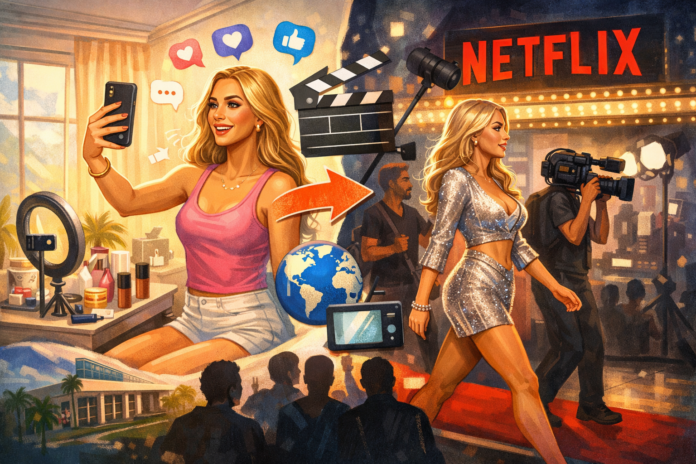
Netflix’s announcement that it will produce an unscripted series following the life of Alix Earle has drawn attention beyond entertainment trade reporting because it intersects with broader questions about how social platforms and mainstream media interact to shape cultural narratives. The series will center on Earle, a creator who first gained recognition through short-form video posts while a student in Miami and who has since participated in network television competition. The show’s existence is not itself surprising. What warrants quiet scrutiny is how this move by a global streamer reframes a form of public engagement that originated outside traditional entertainment networks.
The series was disclosed in press materials and confirmed by reporting this month. Netflix described the project as an exploration of Earle’s personal relationships as well as her life beyond the clips and posts that have marked her trajectory to date. This framing, taken at face value, suggests an attempt to translate a pattern of online engagement into a long-form visual narrative. The translation from platform to platform invites questions about the interpretive frames that global entertainment entities apply to the raw material generated on social platforms.
Earle’s path to this moment began with video clips that documented segments of her day and that often incorporated commentary about products, routines, and personal experience. These posts drew attention and followers, making her a subject of broader media coverage and, ultimately, mainstream television casting. In the process of moving from a relatively local social audience to national television and now to a Netflix series, Earle’s public persona became a site where distinct cultures of media production converge: the rapid turnover of social platforms and the slower, more deliberate pace of network and streaming production.
It is useful to consider what gets explained and what gets elided in reporting about this new series. Coverage generally notes the sequence of Earle’s rise on social platforms, her stint on a televised dance competition, and the forthcoming Netflix project. Beyond these facts, much of the surrounding commentary invites viewers to view this progression as a natural escalation rather than as a transformation in how media entities leverage individual engagement. In other words, the structural conditions that allow someone to gain audience attention on one platform and then be incorporated into another platform’s content pipeline receive less scrutiny than the personalities involved.
This pattern of coverage tends to simplify complex media dynamics into a personal narrative. The individual at the center becomes a proxy for broader trends, with less attention paid to the mechanisms that underwrite the shift from one medium to another. It is one thing to document that a content creator’s work on social platforms led to a streaming deal; it is quite another to examine how different media architectures value and repurpose that work.
From a cultural perspective, the transition from short clips to a series invites reflection on audience expectations and media production imperatives. Social platforms operate with immediacy and brevity, rewarding constant output and rapid feedback. Streaming services operate with longer formats that require narrative arcs, character development, and sustained engagement over episodes. Reconciling these modes of content production and consumption is not a straightforward process. The series about Earle will have to resolve this tension in its editing, pacing, and presentation.
It is also worth observing how coverage frames Earle’s personal relationships within the context of the new series. Announcements about the project emphasize that the camera will follow her interactions with family and close acquaintances. This emphasis echoes longstanding conventions in reality television, where relational dynamics serve as a source of narrative tension. Within this genre, personal associations are often foregrounded to anchor viewer interest. The choice to adopt this framing for an individual whose public presence was initially tied to product commentary and daily routines speaks to the templates that established production entities bring to projects, even when the raw material differs in origin.
The decision by Netflix to greenlight this series also reflects a broader institutional calculus about how to incorporate digital creators into legacy entertainment formats. Streaming platforms seek content that can attract subscribers, encourage sustained viewing, and generate cultural conversation. A subject like Earle, whose name appears in searches and media coverage, may satisfy these criteria in a way that a more obscure creator would not. Yet focusing on a familiar name does not inherently explain why this particular story works as a long-form narrative rather than as an episode in a compilation of creator lives. Much of the early reporting foregoes this nuance in favor of cosmetic descriptions that center on personal milestones.
Observers and analysts who look beyond surface details may note that mainstream media entities have long adapted external cultural forms into their own frameworks. What begins as localized or platform-specific expression often gets absorbed into larger production systems that have different priorities and modes of storytelling. This is not an assertion about individual merit, but a recognition of structural practice in entertainment. In that light, the Netflix series can be seen as part of a pattern in which media institutions selectively translate certain forms of engagement into formats they control.
In Miami, where Earle began her trajectory, the news has been met with a mix of interest and curiosity. Local reporting tends to trace her early uploads to her time as a student at the University of Miami. These details ground her story in a specific geography and moment in time. Miami’s role in this narrative is incidental in some respects but also illustrative of how creative labor originates in many different markets before being redistributed through national and global media networks.
Coverage of the forthcoming series has not dwelt on the precise nature of the economic arrangements between Earle and Netflix. Financial terms, production partners, and distribution strategies have not been publicly disclosed. This silence is typical in early announcements about entertainment projects, where contract specifics are proprietary and subject to negotiation. Observers who seek to understand the institutional logic of such deals must therefore read between the lines of strategic positioning rather than rely on explicit disclosures.
What can be verified is that the series will exist. Its production is underway. It will add another dimension to how Earle is known beyond social platforms. For the broader media landscape, the move by a major streamer to document the life of a creator who gained prominence on social platforms underscores the permeability between different mediascape layers. It also highlights how storytelling conventions are repurposed at scale.
In parsing media coverage of this development, a more reflective interpretation eschews the tendency to frame the news as a narrative of individual ascendancy. Instead, it situates the event within ongoing shifts in production hierarchies, narrative forms, and institutional priorities. The upcoming series is a moment worth observing not because of who is at its center, but because it exemplifies how content built in one register gets absorbed into another and how media institutions continue to shape the terms of public engagement.