In late January 2026, a Bloomberg feature noted that Solo 401k plans, once a niche option for a narrow slice of self employed Americans, are being pushed into the mainstream by Wall Street firms. The effort is part of a broader attempt to capture retirement savings from independent workers whose income does not move through traditional payroll systems. Solo 401ks allow self employed professionals to shelter substantial portions of income in tax advantaged accounts, with annual contribution potential now reaching well into the tens of thousands of dollars.
While attention has focused on the growth of these plans, another shift is taking place more quietly. It concerns how existing 401k capital is treated as account holders move into the later stages of their working lives. For millions of Americans, age 59½ is no longer just a technical marker buried in tax code footnotes. It has become a practical turning point in how retirement capital can be repositioned.
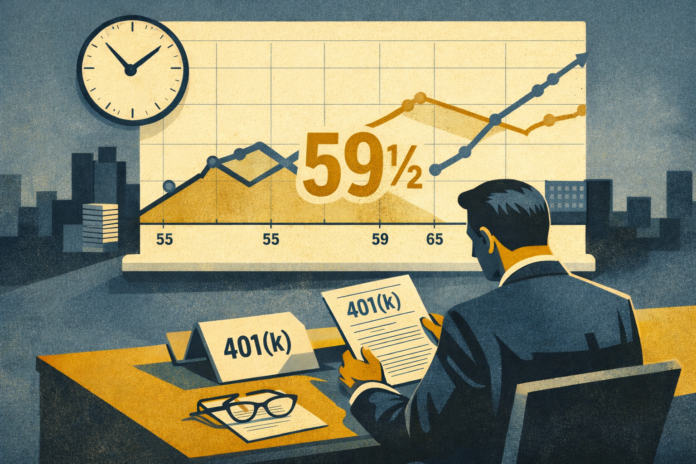
Under current tax law, withdrawals from qualified retirement plans before age 59½ generally trigger an additional ten percent tax penalty on top of ordinary income taxes. Once that age is reached, the penalty disappears, even though income taxes still apply. The distinction is simple on paper, but its implications are often underestimated.
Before 59½, most 401k balances remain effectively locked in place. The penalty structure discourages movement and enforces patience. After that age, the constraint lifts. What follows is not an obligation to act, but an opportunity to decide. That moment, more than the number itself, is what makes 59½ significant.
This decision point arrives as retirement rules continue to shift. For 2026, contribution limits for 401k plans increased again, allowing workers to defer more income than in prior years. Additional catch up contributions remain available for those over 50, and enhanced catch up provisions for individuals in their early 60s continue to apply. These changes have encouraged older workers to concentrate more capital inside tax deferred accounts during their final earning years.
At the same time, institutional interest in retirement vehicles for self employed and small business owners has increased. Solo 401ks, once administratively cumbersome, have become easier to establish and manage. Adoption remains modest compared to traditional employer plans and IRAs, but growth has been steady. As more professionals accumulate retirement assets across multiple account types, the question of how and when to reposition that capital becomes harder to ignore.
For someone approaching 59½, the decision is rarely binary. The removal of the penalty does not automatically mean funds should be withdrawn. Instead, it expands the menu of choices. Some begin structured distributions to supplement income. Others explore rolling balances into IRAs to gain broader investment flexibility. Still others leave funds where they are while adjusting allocation strategy inside the plan.
Don’t Max Out Your 401(k)—Here’s What to Do Instead
Rollovers often sit at the center of this conversation. Tax rules allow eligible distributions from a 401k to be moved into another qualified plan or an IRA without immediate tax consequences if executed properly. These moves are not merely administrative. They change where capital sits, how it is invested, and how future taxes are managed. In practice, a rollover is a repositioning decision that shapes the next phase of an investor’s financial life.
There are also quieter considerations tied to this age threshold. Recent rule changes stemming from retirement legislation have altered how certain contributions must be treated for higher income earners, requiring some catch up contributions to be made on an after tax basis. While these rules affect contributions more than distributions, they influence how investors view the balance between tax deferred and tax free assets as they approach penalty free access.
For professionals in Florida and elsewhere, this means the decision at 59½ cannot be isolated from the broader tax and income picture. A strategy that makes sense at 60 may look very different at 65 or 70, when required minimum distributions, Social Security timing, and other income sources come into play. Repositioning is not a single act but a sequence of choices that unfold over time.
This age threshold also intersects with the growing attention given to self employment and flexible work arrangements. As more individuals hold assets across traditional employer plans, Solo 401ks, and IRAs, the act of consolidating or reallocating those accounts becomes increasingly relevant. Each transfer reflects a decision about control, taxation, and risk exposure.
What emerges from these overlapping trends is a quiet but meaningful shift. Age 59½ has moved beyond its role as a tax technicality. It now functions as a strategic pivot point, one that invites reconsideration of how long held retirement capital should be positioned for the years ahead. As institutions court retirement savers and rules continue to evolve, the choices made at this moment are drawing closer attention from investors and advisors alike.
The capital itself has not changed. The rules around it have. And in that gap between access and action, repositioning begins.
Read More