

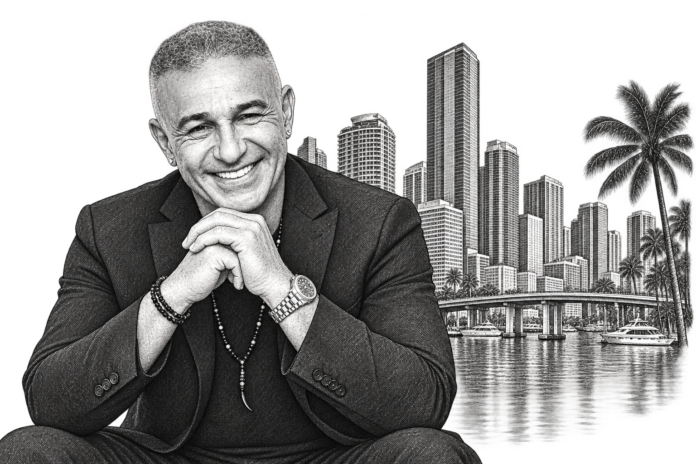
Moishe Mana is assembling downtown Miami property at a scale that turns fragmented real estate ownership into a strategy for controlling how a district evolves.
Moishe Mana has spent years buying pieces of downtown Miami, but the logic behind the purchases becomes clearer when the properties are viewed together. An office tower here. A historic post office there. A development parcel, a retail space, another building along Flagler Street. Individually, they are ordinary units of commercial real estate. Collectively, they begin to resemble something else: an attempt to accumulate enough ownership in one part of a city that the geography itself becomes the investment.
That distinction matters.
In 2026, Mana has continued adding to a downtown portfolio that already encompasses roughly 80 buildings. Among the year’s acquisitions was One Downtown, a 31-story office tower at 1 Southeast Third Avenue, purchased for $110 million. He subsequently acquired the historic 1914 U.S. Post Office and an adjacent development site for $20.3 million, along with additional commercial space and another strategically located property along the Flagler corridor. The transactions were significant individually, but their importance lies less in their size than in where they sit relative to everything Mana already owns.

Mana is not assembling a conventional portfolio in which properties are scattered across markets according to a formula for diversification. He is concentrating capital geographically. His strategy depends on the proposition that owning more pieces of the same urban environment can create value that is difficult to capture when those properties are owned separately.
A building has one value as a building. A building surrounded by assets that can be coordinated, repositioned or eventually redeveloped can have another.
That is the underlying idea behind Mana’s approach to downtown Miami.
The conventional real-estate investor looks for a property whose current economics justify its price. The more ambitious investor may look for an asset whose economics can be improved through renovation, leasing, financing or redevelopment. Mana’s strategy introduces another variable: ownership of the surrounding neighborhood. Once an investor controls enough adjacent or nearby properties, the distinction between owning real estate and shaping a district begins to disappear.
The transformation is particularly visible around Flagler Street, where Mana has been accumulating properties for years. His vision for the area, which he calls the Flagler District, is not limited to individual buildings. It encompasses a broader commercial and cultural ecosystem linking technology, business, fashion, art and entrepreneurship. That vision requires physical control, and physical control requires ownership.
The purchases therefore serve two purposes at once. They provide exposure to the underlying value of Miami real estate, while also increasing Mana’s ability to influence what happens around the assets he already owns.
This is a different form of scale from the one normally associated with institutional real estate.
Scale is usually measured by assets under management, square footage or the total value of a portfolio. Mana’s version of scale is geographic. The objective is not simply to own more property. It is to own enough property in the same place that the relationship between the properties becomes economically meaningful.
That relationship can produce optionality.
A property that appears limited when evaluated on its own can become more valuable when it can eventually be combined with neighboring land. A retail space can benefit from increased pedestrian traffic created by surrounding development. An office building can become more attractive when the district around it develops a stronger ecosystem of restaurants, cultural institutions, residences and businesses. A parking parcel can acquire strategic value because of what could eventually be built beside it.
The individual properties remain the same physical objects. Their potential changes because the ownership structure around them changes.
That is why some of Mana’s acquisitions may look less consequential than others. A $110 million office tower naturally attracts attention. A historic post office and an adjoining parcel purchased for a fraction of that amount may not. Yet from the perspective of an owner assembling a district, the smaller acquisition can be strategically important precisely because it fills a gap.
Urban real estate is inherently fragmented. Streets, blocks and buildings are divided among owners whose interests rarely align perfectly. Redevelopment becomes complicated when a project depends on land controlled by several parties. The owner who patiently acquires those pieces gains something that is difficult to obtain through financing alone: the ability to make decisions without negotiating with every neighboring property owner.
This is where Mana’s strategy begins to resemble infrastructure investing.
Infrastructure is valuable because individual assets operate within systems. A port depends on roads, rail connections and warehouses. A data center depends on networks and power infrastructure. A logistics facility depends on the movement of goods around it. The value of each asset is influenced by the quality and configuration of the system in which it sits.
Urban real estate works in much the same way, although the system is less explicit.
A building is connected to a street, a neighborhood, a transit network, nearby businesses, residential density and the broader economic identity of the city. The more control an investor has over those surrounding pieces, the greater the ability to influence the conditions under which the individual asset operates.
Mana’s real-estate strategy is therefore less about finding isolated bargains than about accumulating influence over those conditions.
His activity in Wynwood offers an earlier example. Mana has assembled a substantial collection of contiguous properties in the neighborhood and pursued a broader development strategy rather than treating each parcel as an independent investment. The same philosophy is now visible downtown, although the urban environment is different. Wynwood offered large areas of underdeveloped land and the opportunity to assemble a district as it changed. Downtown Miami is already dense, established and economically active, which makes the accumulation strategy more complicated and potentially more valuable.
The challenge is no longer simply creating a neighborhood.
It is participating in the next version of one.
Miami has become an unusually important destination for capital because several forces are converging there. Wealth from Latin America has long had a presence in the city. More recently, technology companies, financial firms, entrepreneurs, family offices and wealthy individuals have increased their exposure to South Florida. Miami’s role as a bridge between the United States and Latin America has become part of its investment narrative, but narratives alone do not create economic value. They require physical infrastructure, commercial space, housing, institutions and places where businesses can operate.
Real estate is the physical expression of that capital migration.
Mana’s strategy sits directly inside it.
His interests also extend beyond property. Through Mana Common and related ventures, he has pursued commercial, cultural and entrepreneurial projects intended to connect Miami with international markets. That makes his real-estate holdings more than a passive collection of buildings. They provide physical infrastructure for a broader commercial strategy.
The distinction is important because traditional development tends to separate real estate from the businesses that occupy it. The landlord owns the building; the tenant creates the economic activity. Mana’s model is more integrated. His investments in property, culture, commerce and entrepreneurship can reinforce one another, creating a feedback loop in which the district becomes part of the investment thesis.
That does not make the strategy risk-free.
Concentrated ownership creates concentrated exposure. A portfolio spread across dozens of cities can absorb weakness in one market more easily than a portfolio concentrated in one urban geography. Downtown office demand can change. Construction costs can rise. Development approvals can take years. Interest rates can alter valuations. A neighborhood can take much longer to transform than an investor initially expects.
And ownership alone cannot manufacture demand.
A district does not become successful simply because one investor owns a large percentage of it. Businesses have to want to locate there. Residents have to want to live there. Visitors have to want to spend time there. Infrastructure has to function. The city has to continue attracting capital and talent.
Mana’s bet is that long-term ownership gives him enough exposure to those forces that he does not need to predict exactly when they will arrive.
That patience may be one of the most important characteristics of the strategy.
Real estate is often described as a long-term asset class, but much of modern property investment is governed by relatively short institutional horizons. Funds raise capital for defined periods. Properties are acquired, repositioned and sold. Performance is measured against benchmarks and exit assumptions. The investment thesis often needs to work within a predetermined window.
Mana’s accumulation strategy is different. The value of owning a property may increase not because it can be sold quickly at a higher price, but because it gives him another piece of a larger puzzle.
That changes the meaning of time.
A parcel that does not have an obvious near-term use can still make sense if owning it prevents someone else from controlling a future development opportunity. An aging building can remain valuable because its location matters more than its current income. A smaller property can become strategically important because it connects two larger holdings.
The return is therefore not always visible in the property’s current cash flow.
Some of it is embedded in the optionality created by ownership.
This is what makes Mana particularly relevant to investors studying the evolution of private capital. The strategy illustrates how capital can move from simply owning assets toward owning the conditions that determine how those assets develop.
There are precedents for this approach. Large institutional investors have assembled portfolios around airports, logistics corridors, data centers and other infrastructure networks. Private equity firms have built platforms by combining businesses whose value increases through common ownership. Family offices have accumulated land over decades because they can tolerate holding periods that traditional funds cannot.
Urban real estate provides another version of the same idea.
Instead of asking which individual property will appreciate the most, the investor asks whether controlling a critical mass of properties can change the economics of the entire collection.
That is the logic behind Mana’s downtown accumulation.
The four major acquisitions of 2026 are therefore less interesting as a series of transactions than as evidence of continuity. The office tower, the post office, the development parcel and the other Flagler properties are additions to a strategy that has been developing for years. Each purchase expands the physical footprint of the existing portfolio. Each reduces, however slightly, the fragmentation of ownership. Each creates another set of possibilities for what can eventually be done with the surrounding properties.
The strategy is cumulative.
That is what separates it from ordinary opportunistic buying.
Mana does not appear to be waiting for a single transformative acquisition. He is building the transformation through accumulation.
The result is an unusual form of private-sector influence over an urban environment. A conventional landlord manages a property. A developer manages a project. A district-scale owner can begin managing relationships between properties, businesses and future development opportunities.
The city remains larger than any one owner, of course. Municipal government controls zoning, infrastructure and public policy. Thousands of businesses and residents determine whether a neighborhood actually functions. Capital can shape an urban environment, but it cannot command it.
Still, ownership confers influence.
And enough ownership can change the questions an investor is able to ask.
For Mana, the question is no longer simply what a particular building is worth today. It is what that building could be worth when considered alongside everything else he controls nearby.
That is a fundamentally different way of looking at real estate.
It also explains why the smallest transaction in a portfolio can sometimes be as important as the largest. The $110 million office tower may provide income, scale and visibility. The smaller parcel next door may provide connectivity. The historic building may provide character. The retail space may provide foot traffic. The development site may provide future density.
Their value lies partly in combination.
This is ultimately what Mana reveals about modern capital: ownership itself can become an operating strategy.
The old model of real estate treated the building as the unit of investment. The newer model increasingly treats the platform, the corridor and the district as the unit. Capital is no longer simply being deployed into assets. It is being deployed into networks of assets whose interactions can create additional value.
Mana’s downtown Miami portfolio is an unusually physical expression of that shift.
He is buying buildings, but the thesis is larger than buildings.
He is buying time, optionality and geographic control.
Whether every component of the Flagler District vision succeeds remains uncertain, and urban development rarely follows the clean logic of an investment memorandum. But the strategy is already revealing something important about where sophisticated private capital can find opportunity in mature cities.
The opportunity may not always be in discovering the next great property.
Sometimes it is in patiently assembling enough of the properties that surround it.
That is why Moishe Mana’s downtown acquisitions matter beyond Miami real estate. They offer a case study in what happens when a private investor treats a city not as a collection of individual assets, but as an interconnected capital system.
The buildings are the visible part.
The accumulation is the strategy.
And the real asset may ultimately be the control that emerges when enough pieces of the city belong to the same owner.