


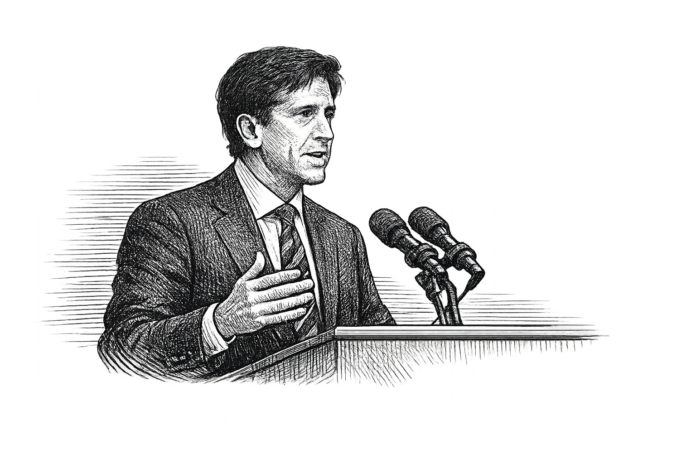
The bond market has always claimed the final vote on monetary policy. Central bankers may set overnight interest rates, publish forecasts, and hold carefully choreographed press conferences, but the market ultimately decides whether those policies deserve belief. That distinction has become increasingly important as inflation, fiscal deficits, and geopolitical uncertainty have forced investors to question assumptions that once appeared settled. When Kevin Warsh emerged as a prominent candidate to lead the Federal Reserve amid renewed concern over inflation expectations and rising long-term Treasury yields, the moment was significant not because of one policy debate, but because it highlighted a deeper evolution in how modern capitalism values central banking. The institution’s most important asset is no longer simply its authority to adjust interest rates. It is the credibility that persuades global investors those decisions will matter.
For much of the twentieth century, monetary policy was understood primarily as a technical exercise. Central banks influenced borrowing costs, regulated liquidity, and attempted to smooth the economic cycle through adjustments to short-term interest rates. Markets certainly reacted, but the institutional hierarchy was largely clear. Policymakers announced decisions; financial markets incorporated them. Over time, however, globalization, financial innovation, and the extraordinary expansion of capital markets altered that relationship. The scale of institutional capital now moving across sovereign borders means investors continuously evaluate not only economic fundamentals but also the confidence they place in the institutions governing them. Central banks no longer operate above markets. They operate within an ongoing negotiation of trust.
Kevin Warsh’s career has unfolded alongside that transformation. Unlike many policymakers whose reputations are built primarily inside academic economics, Warsh has long occupied the intersection of finance, markets, and public policy. His experience on Wall Street before joining the Federal Reserve during the global financial crisis exposed him to the mechanics of capital allocation from both institutional and regulatory perspectives. That combination has consistently shaped how investors interpret his views. Markets do not merely hear an economist discussing inflation. They hear someone whose understanding of financial markets extends beyond theoretical models to the practical behavior of institutional capital.
This distinction matters because modern financial markets increasingly respond to expectations rather than instructions. Asset prices move long before official policy changes occur. Bond yields adjust in anticipation of future inflation. Equity valuations incorporate assumptions about future financing costs. Currency markets continuously reassess the relative credibility of competing central banks. In each case, investors attempt to estimate not simply what policymakers will do, but whether those policymakers understand the forces reshaping capital itself.
The result is a profound shift in what constitutes monetary power. During earlier decades, central banks exercised authority primarily through direct intervention. Today, much of their influence derives from the ability to shape expectations before intervention becomes necessary. Forward guidance, inflation targeting, and carefully calibrated communication have become policy instruments in their own right. Markets spend as much time analyzing speeches, testimony, and subtle changes in language as they do examining actual interest-rate decisions. Credibility has become a balance-sheet asset that exists nowhere on official financial statements but influences trillions of dollars in capital allocation every day.
Warsh represents an important perspective within this evolution because he has consistently emphasized that credibility cannot be manufactured through communication alone. Markets ultimately test every statement against observable economic conditions. When inflation expectations drift upward despite official assurances, investors demand higher compensation for holding long-term government debt. Rising Treasury yields under those circumstances represent more than changing inflation forecasts. They become a referendum on institutional confidence itself.
This explains why bond markets often appear to react disproportionately during periods of policy uncertainty. Investors are not merely repricing economic variables. They are reassessing institutional reliability. Every additional basis point embedded in long-term borrowing costs reflects thousands of independent judgments regarding whether policymakers retain sufficient credibility to anchor future expectations. Those judgments influence mortgage rates, corporate financing costs, infrastructure investment, commercial real estate valuations, and ultimately the cost of capital across the broader economy.
Seen through this lens, debates surrounding central bank leadership become less about personalities than about institutional signaling. Every potential chair embodies a distinct philosophy regarding inflation, employment, financial stability, and market communication. Investors evaluate those philosophies because leadership changes can alter the expected trajectory of monetary policy years into the future. Capital moves not in response to titles but in response to anticipated regimes.
That dynamic illustrates one of the defining characteristics of twenty-first-century capitalism. Increasingly, markets allocate capital according to institutional quality rather than purely economic statistics. Countries with comparable growth rates can experience dramatically different borrowing costs because investors place different values on institutional credibility. Companies operating within trusted regulatory systems often enjoy lower financing costs than competitors facing political or legal uncertainty. Even private-market valuations increasingly reflect assumptions about the stability of legal frameworks, governance standards, and monetary institutions. Credibility has become an investable characteristic.
Warsh’s significance therefore extends beyond any individual policy recommendation. He represents a generation of policymakers shaped by a financial system in which capital moves at extraordinary speed and where confidence can deteriorate almost instantaneously. During the global financial crisis, liquidity vanished not because assets physically disappeared but because trust collapsed. Financial institutions stopped extending credit because they could no longer reliably assess counterparties’ balance sheets. The lesson was enduring: markets fail long before economies fail. Confidence evaporates before capital does.
That insight continues to influence how sophisticated institutional investors interpret monetary policy today. They monitor inflation data, employment reports, and fiscal developments, but they also assess whether policymakers remain ahead of changing market psychology. The distinction is subtle yet essential. Economic conditions influence policy, but confidence determines whether policy retains its effectiveness. Once credibility weakens, restoring it often requires significantly more restrictive measures than would otherwise have been necessary.
The broader implication reaches far beyond the Federal Reserve itself. Modern capitalism increasingly depends on institutions whose authority rests less on coercive power than on accumulated confidence. Credit ratings, accounting standards, legal systems, reserve currencies, and central banks all derive much of their value from widespread belief that they will continue functioning predictably. Their collective credibility lowers transaction costs, encourages investment, and allows capital to flow efficiently across borders and industries. That invisible architecture has become one of the world’s most valuable economic assets precisely because it cannot be manufactured overnight.
Kevin Warsh’s enduring importance lies not in whether one agrees with every policy position he has articulated, nor in whether he ultimately occupies the Federal Reserve’s highest office. His significance lies in what his career reveals about the evolution of monetary authority itself. The central banker of the modern era is no longer simply a steward of interest rates. Increasingly, the role is that of a custodian of institutional trust—an asset that financial markets continuously value, challenge, and reprice in real time.
The transformation of credibility into a form of capital also helps explain why monetary policy has become inseparable from the structure of government finance itself. For decades, central banks could focus primarily on managing the business cycle while assuming that fiscal authorities would operate within relatively predictable boundaries. That separation has become increasingly difficult to maintain. Governments now carry debt burdens that require continual refinancing at market rates, while institutional investors—from sovereign wealth funds and pension plans to insurance companies and central banks abroad—collectively determine the price at which that refinancing occurs. In this environment, every shift in inflation expectations affects not only households and businesses but also the financing capacity of the state itself.
The bond market therefore performs a function that extends beyond valuation. It disciplines institutions. Long-term Treasury yields embody millions of independent assessments about inflation, fiscal sustainability, political stability, and central-bank credibility. When investors demand higher yields, they are not simply anticipating tighter monetary conditions. They are expressing a judgment about the institutional framework that underpins the world’s largest capital market.
Warsh’s career illustrates why this interaction between markets and policy deserves closer attention from sophisticated allocators. His public commentary has often reflected a willingness to view monetary policy through the lens of incentives rather than formulas. Markets are adaptive systems populated by participants who respond to expectations, credibility, and relative opportunity. Policy cannot be evaluated solely by the precision of its models if those models fail to account for how capital actually behaves under changing conditions.
This perspective marks an important departure from a generation of monetary policy that increasingly relied on forward guidance as a substitute for action. Following the global financial crisis, central banks discovered that carefully crafted communication could influence financial conditions without immediate adjustments to interest rates. Guidance became an instrument of policy. Markets learned to interpret language with extraordinary precision, assigning significance to subtle changes in wording that would once have attracted little attention.
The success of that approach depended on one assumption: that the institution issuing the guidance possessed unquestioned credibility. Once that assumption weakens, communication alone becomes less effective. Investors begin demanding confirmation through action rather than reassurance through language. The premium attached to credibility begins to erode.
That evolution reflects a broader shift in modern capitalism. Increasingly, institutions compete not only on the basis of financial resources but also on the quality of their governance. A corporation with disciplined capital allocation often commands a valuation premium over one with comparable earnings but inconsistent strategy. Private equity firms attract long-duration capital by establishing confidence that investment discipline will survive individual market cycles. Family offices preserve wealth across generations not merely by selecting attractive assets but by creating governance systems capable of making rational decisions under uncertainty.
Central banking belongs to the same institutional category. Its effectiveness ultimately depends upon confidence that the framework governing policy will remain coherent even when circumstances become politically uncomfortable. The market is continually evaluating whether that confidence remains justified.
This is where Warsh becomes more than a candidate for public office. He becomes a lens through which to examine the changing relationship between markets and institutions. Investors are increasingly less interested in personalities than in frameworks. They seek signals regarding how future decisions will be made, how uncertainty will be managed, and whether institutional incentives remain aligned with long-term stability rather than short-term accommodation.
The distinction matters because today’s capital markets operate within a vastly different environment than the one that shaped much of twentieth-century monetary policy. Global savings move across borders in seconds. Passive investment vehicles transmit market adjustments at unprecedented scale. Algorithmic trading accelerates price discovery. Derivatives markets continuously express expectations about future policy paths long before official meetings occur. Information has become instantaneous, while confidence remains cumulative. It requires years to build and can deteriorate in remarkably little time.
For institutional investors, this changes the hierarchy of analysis. Economic forecasts remain important, but governance increasingly occupies equal footing. Questions that once belonged primarily to political science or public administration now influence portfolio construction. Can institutions withstand fiscal pressure? Will legal systems remain predictable? Does regulatory policy encourage productive investment or distort incentives? Can monetary authorities preserve price stability without undermining financial stability? These are no longer abstract policy debates. They are investment questions.
Warsh’s significance therefore lies in what his career suggests about the evolution of institutional leadership. Modern policymakers are increasingly evaluated as stewards of confidence rather than administrators of technical policy. Markets assume competence. What they seek is consistency, independence, and a demonstrated willingness to preserve institutional credibility even when doing so imposes short-term economic or political costs.
This is not unique to central banking. Across the architecture of global finance, institutions derive competitive advantage from the predictability of their decision-making processes. Stock exchanges attract listings because issuers trust market integrity. Asset managers gather capital because clients trust fiduciary discipline. Banks earn lower funding costs because creditors trust their balance sheets. Reserve currencies maintain global demand because investors trust the institutions standing behind them. Trust reduces friction, and reduced friction lowers the cost of capital.
That relationship may be one of the defining characteristics of twenty-first-century capitalism. As economies become increasingly financialized, intangible institutional assets begin to rival tangible economic resources in importance. Credibility functions much like a balance-sheet asset that cannot be recorded under conventional accounting rules yet materially influences valuation. Countries with trusted institutions borrow more cheaply. Companies with trusted governance command higher multiples. Investment firms with trusted processes attract patient capital. The same principle increasingly applies to central banks.
Kevin Warsh ultimately represents this institutional transition. His relevance is not confined to debates over inflation, interest rates, or any single Federal Reserve meeting. Those questions will evolve with every economic cycle. What endures is the broader lesson about the changing nature of monetary authority. Central banking has become less about exercising power than about sustaining confidence in the framework through which power is exercised.
Future investors will likely study this period not because of a particular interest-rate decision but because it marked a stage in the evolution of capital itself. Markets no longer separate monetary policy from institutional quality. They increasingly price them together. The premium attached to credibility has become an essential component of sovereign borrowing costs, equity valuations, currency stability, and long-term investment decisions.
That may prove to be Kevin Warsh’s most enduring significance. He illustrates that in modern capitalism, institutions compete not only through the policies they implement but through the confidence they inspire before those policies are ever tested. The most valuable asset on a central bank’s balance sheet is neither its securities portfolio nor its statutory authority. It is the accumulated belief that markets place in its judgment. Every bond auction, every inflation expectation, every movement in long-term yields is ultimately a market assessment of that invisible asset.
The history of capitalism is often written through innovations in finance, ownership, technology, or trade. Yet beneath each transformation lies a quieter force: the institutional credibility that allows capital to move with confidence. Kevin Warsh’s career offers a window into that reality. It reminds us that the future of monetary policy will be determined not simply by the level of interest rates, but by the quality of the institutions entrusted to set them. In an age defined by abundant information and instantaneous capital flows, credibility has become one of the world’s scarcest—and most valuable—forms of capital.