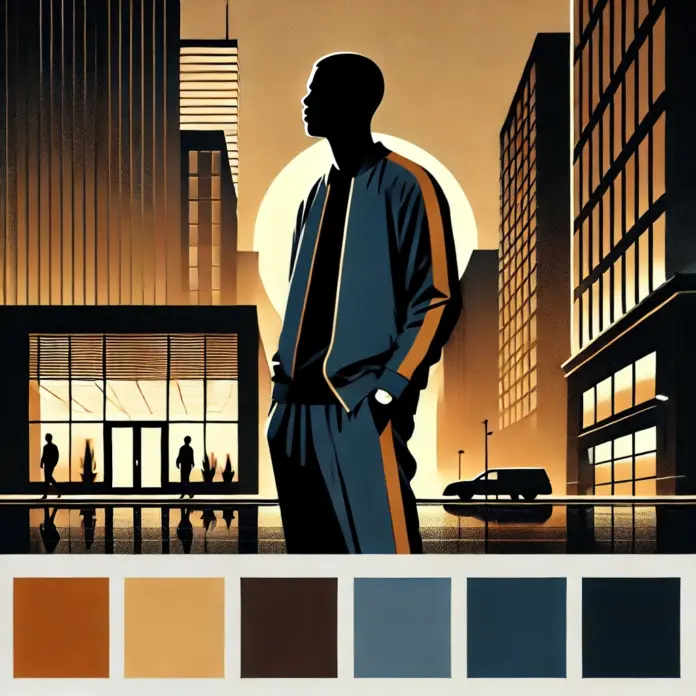
He moved through Crenshaw like a man watching time. Not chasing it — studying it. The sun hit the asphalt in long, gold streaks, stretching over the block he’d turned into a brand, a belief, a blueprint.
In a city obsessed with moments, he built for momentum. Every move deliberate, every lyric an invoice to the culture that raised him.
There was something in the way he spoke — slow, steady, surgical — like he was dictating the minutes of a meeting no one else knew was happening. While others burned bright, he burned through. The difference was intention. “It’s a marathon,” he’d say, but it wasn’t a slogan. It was strategy disguised as scripture.
He’d watched the game chew up the gifted — fast money, faster losses. But he studied the system, the labels, the leases, the percentages. And somewhere between studio sessions and street corners, he discovered the truth: ownership was the only real luxury.
He didn’t want a seat at the table. He wanted the deed to the building.
Marathon Clothing wasn’t just a store — it was a thesis on self-determination. The shelves carried more than cotton; they carried equity. Each logo embroidered like a quiet rebellion against dependency. People came to buy T-shirts but left with permission — to dream on their own terms, to walk their own marathon.
In private moments, he’d stand on the balcony of Slauson Ave, the city buzzing below like static. He’d light a joint, watch the skyline flicker, and think about the blueprint — how to build wealth that outlived applause. He knew success was a risk. But anonymity was worse.
They called him a rapper, an activist, a visionary. He called himself a student of the game. And like any good student, he took notes. Every verse, every investment, every risk — annotated with intention. Where others saw blocks, he saw balance sheets. Where others chased status, he chased structure.
There was tragedy, yes — the kind that rips the timeline in two. But legacy isn’t measured in lifespan. It’s measured in impact.
Even now, the air on Crenshaw still hums with his cadence — that blend of hustle and holiness, boardroom precision wrapped in street vernacular. His philosophy lingers in the margins of ambition: Own your narrative before someone licenses it.
Because every Empresario learns the same truth — power isn’t given; it’s branded.
The city kept moving, but his ideas stayed — repackaged as motivation, as murals, as memory. The Marathon continues — not as a slogan, but as a contract written in hustle and sealed in purpose.
He didn’t just sell music. He sold sovereignty.
He didn’t just build a business. He built belief.
And when the lights hit his mural at sunset, you realize — he never really left. He just moved higher on the skyline.

Louie Molina is the host and architect of The Empresario. Drawing from years of financial design and strategic consulting, he created The Empresario Reserve as the ultimate repositioning strategy — a system that turns financial instruments into instruments of control.