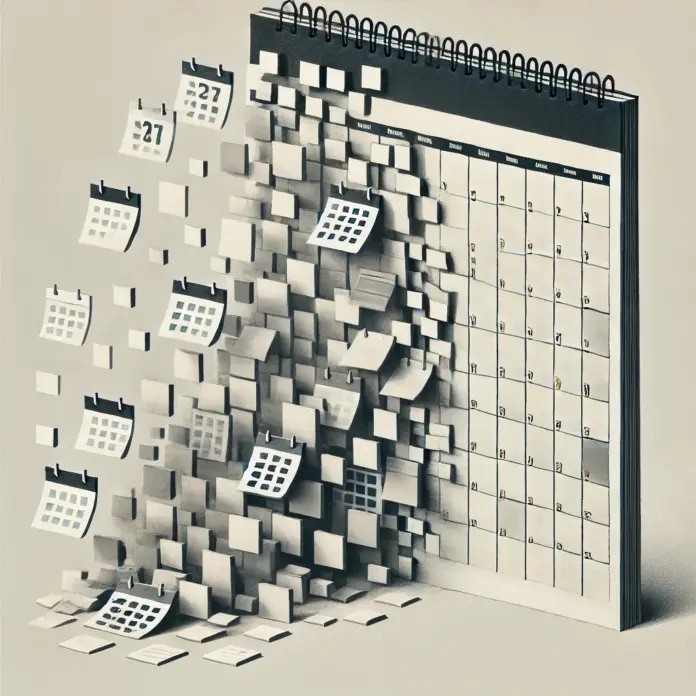
By midafternoon, the city settles into a familiar rhythm. Lines move slowly. Phones are checked often, rarely with consequence. People drift from one obligation to the next with practiced efficiency, as if momentum itself were a form of progress. No one appears idle. That, perhaps, is the point.
The sidewalks are full, but the conversations are thin. Everyone is doing something. Errands are stacked back-to-back. Appointments overlap. Messages arrive faster than they can be answered, yet most of them lead nowhere in particular. Activity fills the day the way humidity fills the air—constantly present, hard to escape, rarely questioned.
This is not laziness. It is effort. Real effort. The kind that leaves people tired by evening and vaguely dissatisfied by morning. The kind that creates the sensation of forward motion without the certainty of arrival. Busyness has become the accepted posture of ambition, especially in places where standing still feels indistinguishable from falling behind.
In this environment, stillness is suspicious. Pauses invite explanation. To be unreachable, even briefly, requires justification. The day rewards responsiveness, not reflection. The fastest reply wins the moment, even if it costs the larger arc. Over time, urgency becomes a reflex, and reflex is mistaken for intention.
What’s striking is how rarely advancement is discussed directly. People talk about being “swamped,” about weeks that disappeared, about how quickly time is moving. They talk about exhaustion with a strange pride, as if fatigue itself were evidence of progress. What goes unspoken is whether any of this motion is compounding into something sturdier than tomorrow’s to-do list.
Busyness, after all, is a reliable shield. It protects against harder questions. If the calendar is full, there is no need to examine direction. If the day is crowded, there is no room to notice repetition. Movement becomes its own justification. The hours pass, and the absence of change is attributed to timing rather than structure.
There are moments when this becomes visible—briefly, uncomfortably. A canceled plan that reveals how little would actually collapse if one task were removed. A quiet afternoon that exposes how much effort goes into maintaining the appearance of momentum. These moments rarely last. Noise returns quickly. Something always fills the gap.
In places like this, advancement is subtle, almost private. It doesn’t announce itself through volume or speed. It often looks like less: fewer commitments, narrower focus, longer pauses between decisions. From the outside, it can resemble disengagement. From the inside, it feels like control slowly being reclaimed.
Occasionally, someone steps out of the current. They leave early. They stop explaining their availability. They allow messages to wait. Nothing dramatic happens. The world does not reward them immediately. In fact, they may appear to fall slightly out of sync. But over time, their days begin to look different. Less crowded. More deliberate. Their effort starts to accumulate instead of dissipate.
Most people never make this shift, not because they lack discipline, but because the environment discourages it. Busyness is socially legible. Advancement is not. One can be seen; the other must be inferred. In a culture that measures effort by visibility, the quiet work of repositioning goes largely unnoticed.
There is a certain melancholy in realizing how many days can be filled without anything truly changing. Yet there is also relief in understanding that activity is not destiny. The city hums along, rewarding motion, but indifferent to direction. It does not intervene. It does not warn. It simply keeps moving.
Somewhere between one errand and the next, a quieter truth lingers. Progress is rarely loud. And the difference between being busy and advancing is not effort, but arrangement. The day does not make room for this realization on its own. It appears only when something is allowed to remain undone.

Louie Molina is the host and architect of The Empresario. Drawing from years of financial design and strategic consulting, he created The Empresario Reserve as the ultimate repositioning strategy — a system that turns financial instruments into instruments of control.