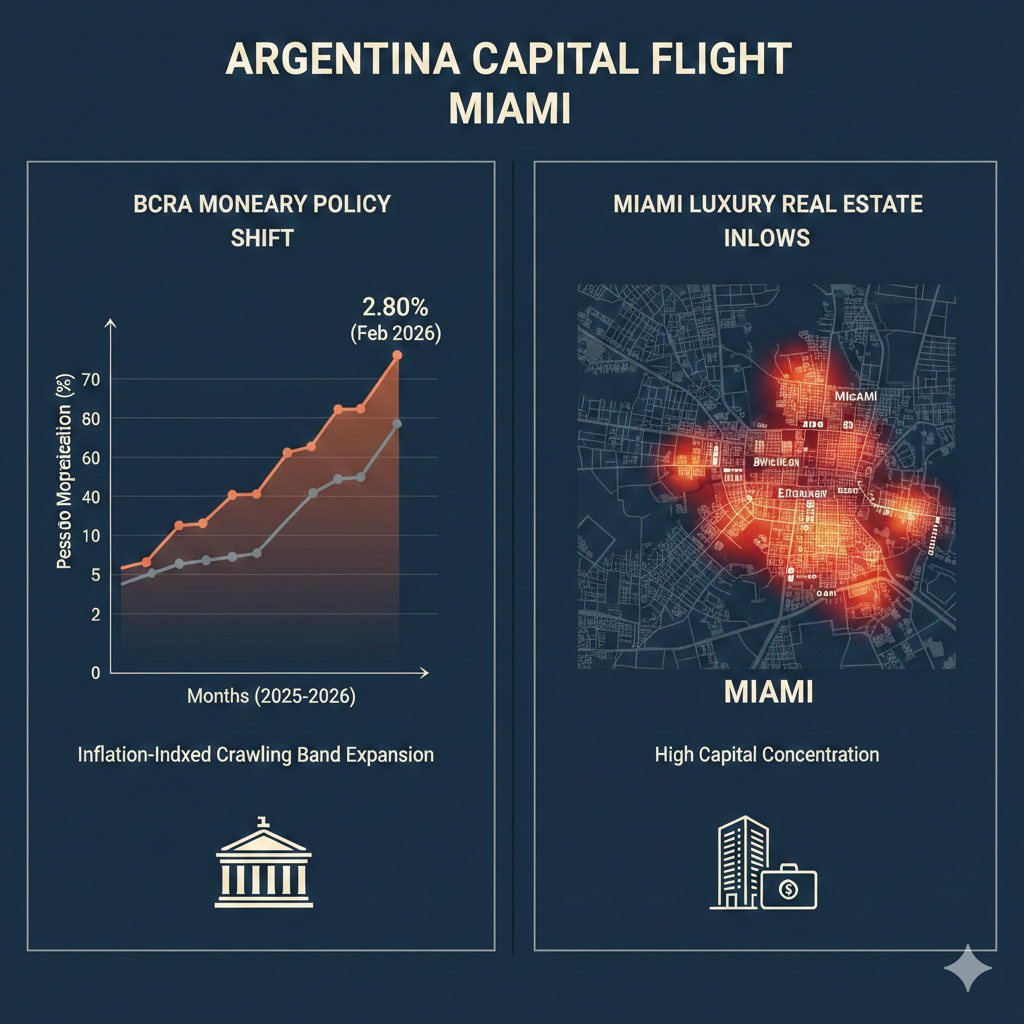


Argentina Capital Flight Miami and the BCRA Pivot
On January 2, 2026, the Banco Central de la República Argentina (BCRA) implemented its third monetary framework under the Milei administration: an inflation-indexed crawling band. For February 2026, the band is set to expand by 2.80%, indexed directly to December 2025 inflation data. This mechanism abandons the previous “nominal anchor” of a 1.00% monthly crawl, signaling to UHNW operators that peso depreciation is now a structural certainty rather than a speculative risk. Consequently, Argentina has solidified its position as a top-three foreign investor in South Florida, contributing to a market where international buyers drive 52.00% of all new-construction sales.
Structural Hedging via Miami Luxury Real Estate
The shift to an indexed band has fundamentally altered the capital preservation thesis for Argentine family offices. Predictable monthly currency expansion between 2.50% and 3.00% has forced a pivot from liquidity preservation in Buenos Aires to hard-asset yields in the Miami–LATAM corridor. Miami-Dade real estate remains the primary recipient of this “refuge capital,” with international transactions in the region being 86.00% Latin American-led. Cash transactions now account for 51.00% of these international deals, insulating the high-end segment from domestic U.S. interest rate volatility.
Jurisdictional Arbitrage and Delaware Statutory Trusts
The current legal architecture of the corridor favors institutionalized landing vehicles over individual holdings. We are tracking an increased utilization of Delaware Statutory Trusts (DSTs) and Florida Limited Partnerships among Argentine principals to facilitate asset consolidation. These structures provide the necessary “tax alpha” and liability protection required for cross-border movement. As the BCRA replenishes reserves through dollar purchases—aiming for a $10 billion accumulation in 2026—the operational window for capital exit remains atypically wide, encouraging front-loaded deposits on Miami pre-construction units.
Latin America Scrambles for Dollars as USD Dominance Strengthens
All-Cash Market Immunity to U.S. Interest Rates
A defining characteristic of the 2026 Argentina capital flight Miami corridor is the dominance of all-cash acquisitions, which reached 51.00% of international residential volume. This liquidity profile grants Argentine UHNWIs a competitive “velocity advantage” over domestic buyers who remain sensitive to the 6.70% average mortgage rates. By bypassing traditional financing contingencies, these operators are securing prime inventory in submarkets like Brickell and Edgewater where supply remains tight. This trend reflects a broader shift toward “safe-haven” capital deployment, where the primary objective is the immediate conversion of volatile peso-denominated wealth into dollar-indexed real estate.
Triple Constraint Dynamics and Exit Liquidity
Argentina entered 2026 facing a triple constraint of near-zero net reserves, peso overvaluation, and $20 billion in debt obligations. While the January 2026 payment of $4.3 billion was met through a bank repo and U.S. Treasury swap line, the remaining $15.7 billion in maturities fuels a persistent “devaluation expectation.” Strategic operators view the current BCRA reserve accumulation program as a finite window of exit liquidity. This has led to a surge in $1 million+ condo purchases, as Argentine buyers prioritize “lock-and-leave” assets that offer ease of remote management and high rental demand.
Branded Residences as Lifestyle and Financial Hedges
The preference for branded residences has reached an inflection point, with Argentine buyers targeting vertical hospitality-adjacent projects. These assets are favored for their design language and service culture, which align with the UHNW “lifestyle-as-an-asset” philosophy. Projects such as 888 Brickell by Dolce & Gabbana are capturing significant interest because they provide a turnkey solution for capital preservation. Furthermore, the 71.00% share of international buyers intending property for vacation or rental use highlights the importance of rental flexibility in these high-rise developments.
Operator Strategy in the 2026 Corridor
Operator Grid data confirms a transition from speculative momentum to disciplined value-add strategies. UHNW operators are concentrating 35.00% of portfolio allocations into Brickell multifamily and AAA office assets for stability, while 15.00% is being diverted to Edgewater waterfront developments for geographic diversification. The preference for branded residences has surged, specifically those offering short-term rental flexibility as a hedge against settling price growth in the broader South Florida market. This institutionalization of the Argentine buyer profile marks a permanent shift in the Miami–LATAM capital nexus.