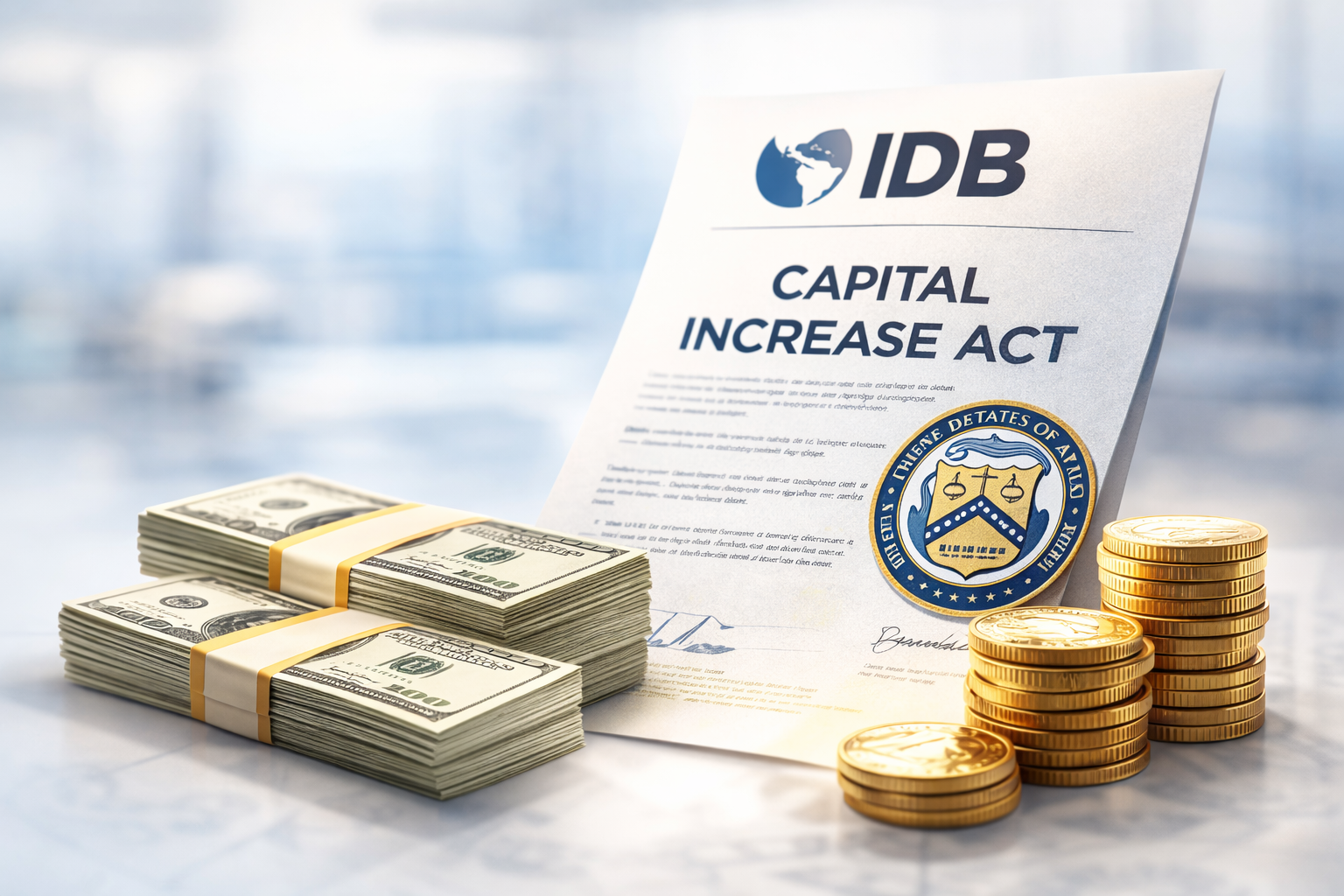


Legislative Expansion of U.S.-Backed Credit Capacity
The United States enacted the IDB Capital Increase Act, authorizing the Treasury to subscribe 25,000 additional shares in IDB Invest, materially expanding multilateral private-sector financing capacity across Latin America.
Legislative and Capital Data Points
- 25,000 newly authorized shares for U.S. subscription to IDB Invest
- Formal Treasury participation under the IDB Capital Increase Act
- Expanded lending headroom targeting private-sector growth
- Strategic focus: infrastructure, energy, SME and mid-market credit
- Direct exposure corridors: Brazil, Mexico, Colombia, Argentina, Central America
Dollar Liquidity Pressure Meets Sovereign Credit Backstop
Latin American corporates remain structurally dependent on dollar financing while facing elevated U.S. rate conditions and tighter global liquidity. Sovereign refinancing cycles in Brazil, Colombia, and Argentina have widened spreads and increased risk sensitivity to political volatility. Capital seeking yield has grown more selective, particularly where policy stability is uncertain.
The U.S. capital expansion into IDB Invest introduces a sovereign-backed credit stabilizer into this environment. Projects and private credit structures aligned with the multilateral balance sheet inherit institutional risk compression. For the Miami–LATAM corridor, where family offices intermediate regional exposure through Florida entities, this strengthens the Pull toward structured vehicles anchored in U.S.-influenced governance standards.
Risk Compression as Hidden Leverage
Public discourse frames this as development finance. The structural effect is risk repricing. Multilateral participation lowers counterparty perception without requiring immediate domestic reform in host jurisdictions.
Operators concentrated in direct sovereign bonds or unsecured corporate exposure face increasing sensitivity to policy shocks and election cycles. By contrast, capital aligned alongside IDB-backed structures gains implicit geopolitical insulation. The jurisdictional advantage consolidates around U.S.-regulated platforms and Miami-based legal structuring, reinforcing South Florida’s role as the corridor’s credit command center.
Positioning Within the Multilateral Umbrella
Reevaluate LATAM allocations held through standalone sovereign or high-yield corporate instruments. Prioritize co-investment platforms, private credit vehicles, and infrastructure funds incorporating IDB participation or parallel underwriting.
This is a balance sheet expansion with geopolitical intent. Capital operating within multilateral architecture benefits from structural protection. Capital operating outside it absorbs unbuffered sovereign risk.
ign risk.