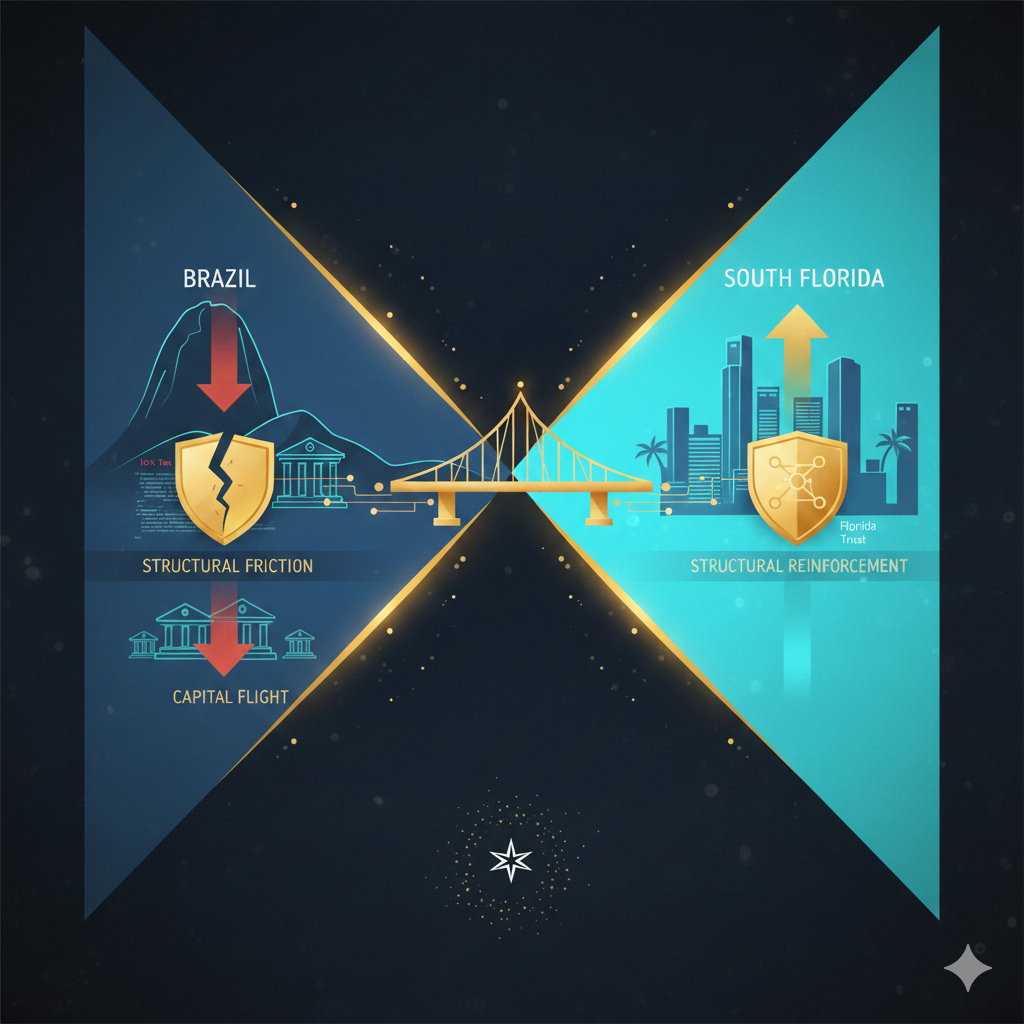


The era of jurisdictional ambiguity for Brazilian wealth has reached a definitive conclusion, replaced by a regime of high-transparency and immediate fiscal liability. As of early 2026, the implementation of Brazilian Tax Reform 2026 protocols—specifically the synchronization of Law 14.754/2023 with the new 10% domestic dividend tax—has neutralized the long-standing efficiency of offshore deferral.
For ultra-high-net-worth families, the annual 15% mandatory levy on foreign-controlled profits on December 31st is no longer a theoretical risk but a structural reality. Consequently, the Desk observes an unprecedented “Capital Realignment” as São Paulo family offices abandon legacy shell companies in favor of Florida-based trust architecture.
The Signals
- Signal: Implementation of Law 14.754/2023 and Law 15.270/2025 ends tax deferral for Brazilian-controlled offshore entities, imposing a mandatory 15% annual tax on CFC profits.
- Impact: Massive migration of Brazilian UHNWI capital from Caribbean “shell” companies into Florida statutory trusts and PPLI (Private Placement Life Insurance).
- Threshold: Brazilian residents with over BRL 600,000 in annual income face a new 10% minimum effective tax (IRPFM), incentivizing permanent relocation to the Miami corridor.
Executive Summary
The era of jurisdictional ambiguity for Brazilian wealth has reached a definitive conclusion, replaced by a regime of high transparency and immediate fiscal liability. As of early 2026, the implementation of Brazilian Tax Reform 2026 protocols—specifically the synchronization of Law 14.754/2023 with the new 10% domestic dividend tax—has neutralized the long-standing efficiency of offshore deferral. For ultra-high-net-worth families, the annual 15% mandatory levy on foreign-controlled profits is no longer a theoretical risk but a structural reality. Consequently, the Desk observes an unprecedented “Capital Realignment” as São Paulo family offices abandon legacy shell companies in favor of Florida-based trust architecture.
Paula De la Mora and the Safe Haven Strategy in Miami
This fiscal tightening in Brazil is met by a robust “Pull Factor” in South Florida. Miami is no longer merely a luxury destination; it has evolved into a sophisticated jurisdictional shield. Current market data suggests that over $10 billion in Brazilian-managed capital is currently in the process of structural repositioning. This migration is fueled by a desire to avoid the 10% domestic dividend tax and the new Minimum Personal Income Tax (IRPFM).
The future of this corridor will be defined by institutional permanence. While previous waves of capital were speculative, the Brazilian Tax Reform 2026 framework forces a binary decision: either accept significantly higher tax leakage in Brazil or migrate capital to the Florida shield. The Desk identifies the latter as the only rational path for long-term wealth preservation.
ASSESSING THE LIQUIDITY RISK UNDER BRAZILIAN TAX REFORM 2026
Under the current framework, the Brazilian Federal Revenue Service (RFB) has inaugurated aggressive Controlled Foreign Corporation (CFC) rules. Previously, a resident could maintain an offshore company in the BVI or Cayman Islands and only pay tax upon repatriation. Today, the Brazilian Tax Reform 2026 protocols treat these profits as “available” on December 31st annually. This results in a 15% mandatory tax on all financial investments and virtual assets, regardless of whether a distribution occurs.
FLORIDA STATUTORY TRUSTS VS. PPLI: THE NEW WEALTH SHIELD
In response to the friction created by Brazilian Tax Reform 2026, the Miami financial district is experiencing a surge in sophisticated structuring. Brazilian family offices are pivoting toward two primary vehicles to regain tax efficiency:
- Florida Community Property Trusts: These allow for a “double step-up” in basis upon the death of a spouse, a massive advantage for cross-border families holding appreciated US assets.
- Private Placement Life Insurance (PPLI): Because PPLI is technically an insurance contract, it remains outside the scope of the 15% annual CFC tax, provided it meets strict diversification and control standards.
THE BRICKELL PULL: WHY MIAMI IS THE TERMINAL DESTINATION
The data from MIAMI Realtors and Cushman & Wakefield confirms that Brazilian investors now represent a significant percentage of all-cash transactions in the Brickell and Coral Gables sub-markets. As the Brazilian Tax Reform 2026 legislation reduces domestic liquidity, the shift toward US-dollar-denominated assets in Florida provides both a currency hedge and a superior legal environment.
The Interpretation:
South Florida is no longer just a recipient of capital flight; it is a primary intelligence theater. The “Structure Onshoring” trend is transforming Miami into the “New Zurich” of the Americas.
For official legislative updates, refer to the Diário Oficial da União (Brazil) or the Florida Department of State.