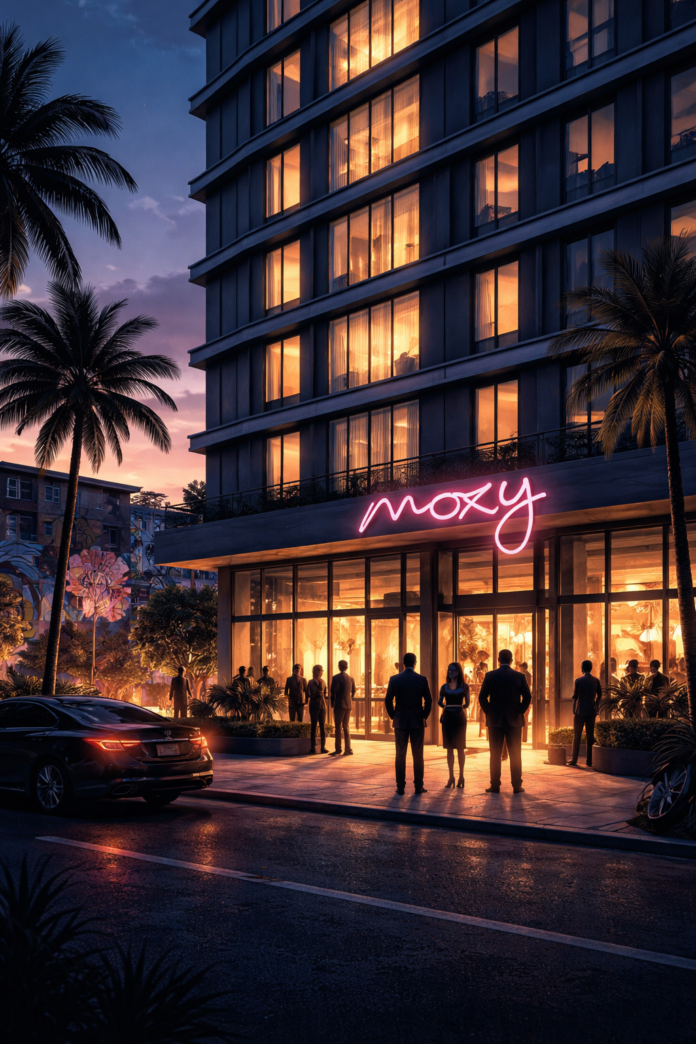
A table of documents sat stacked near the south‑facing windows of the Moxy Miami Wynwood’s ground‑floor lounge a few minutes before the scheduled closing. Conversations buzzed in the margins of the reception area at 255 Northwest 25th Street when phones lit up and voices drifted away from their screens without explanation. Investors and advisors lingered over café chairs, waiting for a conversation that never came.
On the afternoon the Istanbul‑based Süzer Group became the majority owner of the eight‑story boutique hotel along Northwest 25th Street, behavior in the corner spaces mattered more than any press release. Süzer Group agreed to pay $99 million for a 52 percent stake in the property, which had recently opened with 120 keys and multiple food and beverage spaces, including Sparrow Italia and Casa Madera. The seller, a joint venture between Baywood Hotels and Dolphin Capital Partners, retained the remaining 48 percent. Baran Süzer, vice chairman of Süzer Group, signed the deal and left without addressing the small cluster of advisors watching the process.
A senior loan of $35.5 million from Synovus Bank was arranged at the same time, an action whose ripple was already visible in the hallways inside and outside the Wynwood property. Charlie Ryan and Adeel Amin of Hunter Hotel Advisors had handled the senior financing on behalf of Baywood and DolphinBay Hospitality. One broker checked his watch while another adjusted the stack of key cards on a side table, neither conveying what future occupancy might bring.
The deal did not close before sunset. As light shifted across the outdoor murals near the Wynwood Walls, tables in the hotel’s bar area filled with conversations about service partnerships and new rooftop concepts that had been discussed but never finalized. The rooftop space, leased in partnership with CC Social Club and used for events like Art Basel gatherings, stood empty at that hour, lights off.
Inside, staff members passed through the lobby, carrying clipboards or guiding vendors who had dropped by without an appointment. Some paused at the reception desk to adjust room assignments on the screen. At one point, a group of local restaurateurs appeared at the restaurant entrance to observe a scheduled tasting that was delayed beyond its allotted slot and eventually shelved without explanation.
On the sidewalks outside, curious observers paused near valet stands and debated whether the arrival of a European investor would change the rhythm of hospitality in the Arts District. A few drivers pulled up and unloaded luggage for other hotels in the neighborhood. Passersby walked past the front doors without shifting their steps, their conversations continuing about brunch reservations and gallery openings. Inside the building the transaction was technically complete, but the effect felt incomplete.
There was no announcement inside the back corridors where staff gathered portfolios and clipped badges to belts. No collective exhale nor whispered relief. A few individuals simply moved on to their next task, glancing back toward the hall where documents had been signed earlier in the afternoon.
Just as quickly as it had drawn a crowd, the group dissolved. The property’s ownership structure had changed, but the lobby furniture remained in the same positions. Conference rooms once reserved for negotiation now stood empty, their walls strewn with voice mail notifications no one had yet cleared.
In the end, what happened at 255 Northwest 25th Street was not marked by a single declaration or status update. The shift in control at the Moxy Miami Wynwood was written into public records, and yet the moment settled into silence, leaving the hotel to continue its evening routine under new stewardship.