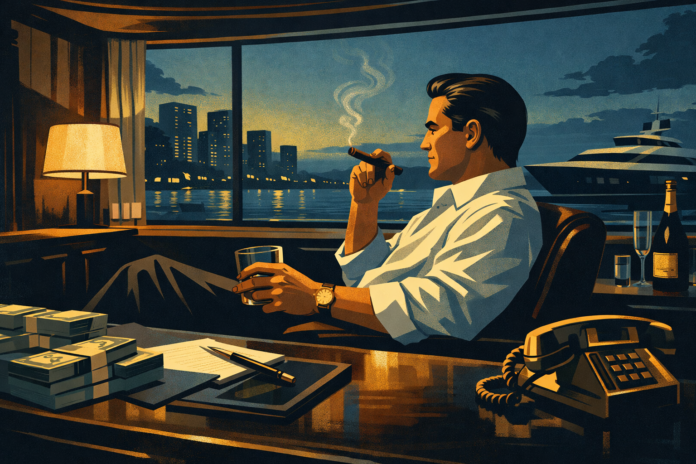
The first thing you notice is the noise. Phones ringing like alarms, bodies colliding in narrow hallways, money flung into the air as if gravity itself has been laid off. It is not chaos exactly—it is choreography. Everyone is moving, talking, closing, pitching, conquering. Somewhere beneath the din, a quieter question hums: what happens when motion becomes a substitute for purpose?
Martin Scorsese’s The Wolf of Wall Street (2013) arrives disguised as excess—three hours of velocity, vice, and verbal combustion—but it is, at heart, a film about performance. Jordan Belfort, played with unsettling buoyancy by Leonardo DiCaprio, is not merely a stockbroker. He is an entrepreneur of appetite, a brand architect whose true product is belief. Belief in money. Belief in inevitability. Belief that if the room keeps moving fast enough, no one will ask where it’s going.
Wall Street. The Exit That Never Came
Set against the manic optimism of late-1980s capitalism, the film charts the rise of Stratton Oakmont, a firm built less on finance than on persuasion. Belfort doesn’t sell stocks; he sells certainty. His genius—if we’re being honest enough to call it that—is understanding that markets are emotional theaters and that leadership, in America, often looks like confidence spoken loudly and often enough to pass for truth.
Scorsese never moralizes. That’s what makes the film dangerous—and valuable. The camera doesn’t flinch as bodies are commodified, ethics are blurred, and success becomes a narcotic. Instead, it watches the way an entrepreneurial identity calcifies. Belfort’s rituals—pounding his chest, barking orders, delivering profane sermons to his staff—aren’t indulgences. They’re maintenance. A founder shoring up belief in the myth he’s created, terrified that if the noise stops, the silence will expose him.
What The Wolf of Wall Street understands—and what many business books politely ignore—is that entrepreneurship is often a performance staged to reassure the performer. Belfort needs the crowd as much as they need him. The office becomes a theater, the sales floor a sanctuary, the microphone a confessional. Money is merely the applause.
The film’s brilliance lies in its refusal to distinguish clearly between charisma and delusion. Belfort’s motivational speeches are absurd, yes, but they’re also effective. He builds loyalty. He creates culture. He gives people an identity larger than their resumes. In another context—cleaner, quieter, better dressed—he might be celebrated as a visionary. Scorsese seems less interested in condemning him than in asking how thin the line really is.
Watching it now, more than a decade later, the film feels less like satire and more like a mirror. Replace penny stocks with startups, cold calls with pitch decks, and Long Island excess with Silicon Valley minimalism, and the psychology remains intact. The modern entrepreneur is still rewarded for velocity. For storytelling. For the ability to turn confidence into capital before anyone checks the math.
There is a telling moment late in the film, after the empire has cracked and the consequences have arrived. Belfort stands before an audience once more—not to sell stocks, but to teach others how to sell. He holds up a pen and asks them to convince him to buy it. The room hesitates. The machine no longer hums. Without the myth, without the frenzy, persuasion suddenly requires substance.
That scene lingers because it exposes the film’s quiet thesis: entrepreneurship untethered from purpose eventually eats itself. Motion without meaning becomes noise. Scale without responsibility becomes parody. Belfort was never punished for greed alone; he was punished for mistaking activity for value, momentum for destiny.
At The Empresario, where ambition is treated with respect but not reverence, The Wolf of Wall Street plays like a cautionary fable disguised as a victory lap. It doesn’t warn us against wanting more. It warns us against wanting nothing underneath it. Against building enterprises that cannot survive stillness.
In the end, Belfort doesn’t lose because he aimed too high. He loses because he never stopped to ask why he was climbing. The tragedy isn’t the crash—it’s that even at the peak, surrounded by money, movement, and noise, there was never a moment of arrival. Only the next pitch. The next room. The next illusion.
And perhaps that’s the most unsettling insight the film leaves behind: in a culture that rewards speed and spectacle, the most dangerous thing an entrepreneur can do is slow down long enough to look at what they’ve built—and see themselves reflected in the glass.