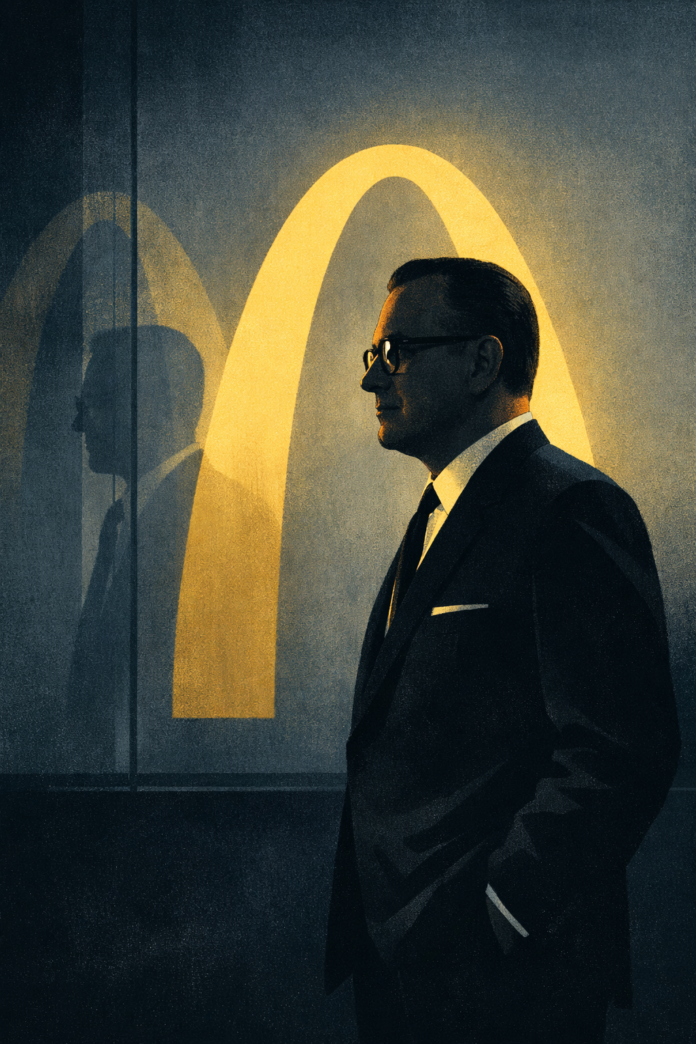
There is a particular loneliness to highway America at dusk. Neon signs flicker on. Windshields hum. Somewhere between one exit and the next, ambition rehearses its lines. The Founder, John Lee Hancock’s 2016 film about Ray Kroc and the McDonald brothers, lives in that in-between space—where optimism hardens into strategy, and handshakes quietly give way to contracts.
The film opens not with triumph, but with repetition. Ray Kroc sells milkshake machines from the driver’s seat of his car, practicing enthusiasm the way a man practices breathing. He is not a visionary. He is persistent. He believes, with almost religious intensity, that belief itself counts as merit. When he stumbles upon the McDonald brothers’ operation—a kitchen engineered for speed, consistency, and restraint—he recognizes perfection immediately. Not because he invented it, but because he knows how rarely it appears.
The Founder is often debated as a moral story. Was Ray Kroc a villain or a realist? Were the McDonalds naïve or principled? But morality is the least interesting question the film raises. What matters more is structural literacy. This is not a story about good people and bad people. It is a story about who understood where power actually lived.
The McDonald brothers believed they owned McDonald’s because they created it. They believed love for the brand was the same thing as authority over it. Their integrity was genuine. Their systems were elegant. Their mistake was assuming those two things were interchangeable.
They were not.
Ray Kroc’s genius—if it can be called that—was not innovation. He did not improve the burger. He did not redesign the kitchen. He did not invent speed. What he did invent was control without invention. He recognized that the real product was not food, but replication. And replication, unlike recipes, requires enforcement.
The film’s most revealing moments are quiet ones. Contracts passed across tables. Clauses read too quickly. Assumptions left unstated because they feel impolite. Kroc smiles through negotiations not because he is hiding intent, but because he knows intent does not matter once structure is set. The future belongs to whoever owns the rules, not whoever tells the best origin story.
This is where The Founder becomes uncomfortable for modern entrepreneurs. We are trained to romanticize authenticity, to believe that culture protects us, that goodwill is a form of leverage. The film dismantles this fantasy methodically. Integrity, it suggests, is not a defense mechanism. Systems are.
Kroc does not overpower the McDonalds. He outgrows them. He surrounds their creation with infrastructure—franchise agreements, supply chains, real estate holdings—that slowly renders their authority ceremonial. By the time they realize what is happening, there is nothing left to argue over. The system no longer needs them.
The real masterstroke of the film is its treatment of contracts as emotional objects. They are not cold documents; they are expressions of belief. The McDonalds believe the spirit of their agreement will protect them. Kroc believes only the letter matters. One side operates on trust. The other operates on enforceability. History sides with the latter.
In business culture, we like to believe that ideas are scarce and execution is common. The Founder flips this assumption. Ideas are abundant. What is rare is the willingness to formalize power—to turn vision into obligation, and obligation into permanence. Kroc understands that systems do not care how they are perceived. They care only that they function.
The Empresario reads The Founder as a cautionary tale disguised as a success story. It is not warning us about betrayal so much as it is exposing a recurring error: founders who confuse emotional ownership with legal ownership inevitably lose both. Admiration does not scale. Contracts do.
There is a subtle cruelty to this realization, and the film does not soften it. The McDonalds retreat into silence, their principles intact but irrelevant. Kroc moves forward, louder than ever, his name eventually synonymous with the empire he did not build, but now controls. The film refuses to give us a villain we can dismiss easily. Instead, it gives us a system doing exactly what it was designed to do.
In the end, The Founder is not about hamburgers or hustle. It is about the quiet transfer of leverage that occurs when structure outpaces sentiment. When founders assume the world will honor intent. When they forget that business, unlike friendship, only recognizes what is written down.
The movie leaves us with an unsettling truth: the most powerful moves are rarely dramatic. They are administrative. And by the time they feel personal, they are already irreversible.