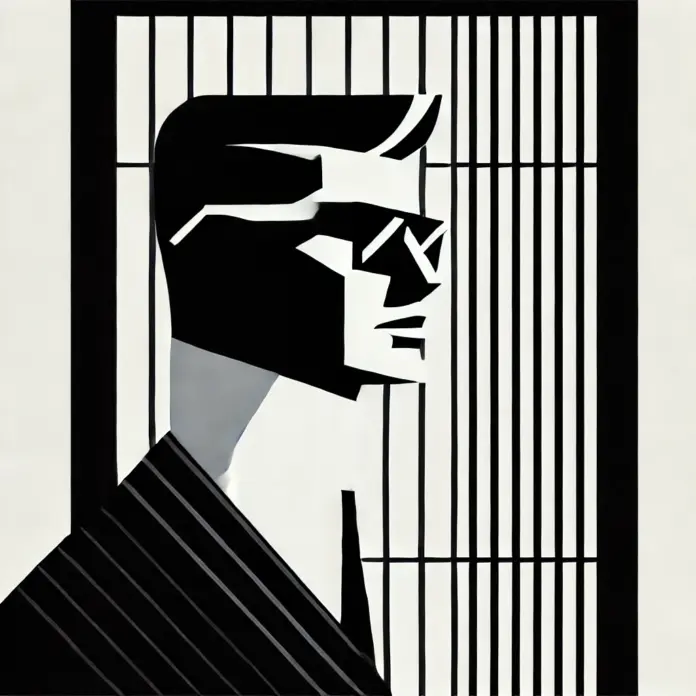
He entered the fashion world the way a comet enters the night sky — silently at first, then so blindingly bright that everyone pretended they had seen him coming. Karl Lagerfeld was not merely a designer; he was an apparition, a silhouette carved in monochrome, gliding through ateliers and after-parties with the certainty of a man who understood one immutable law: style is not a choice. It’s an identity.
Paris in the late 20th century was a city addicted to nostalgia, still mourning its couture ghosts — Balenciaga, Dior, Saint Laurent. But Lagerfeld arrived like a disruption, a challenge, a whisper that the past was not sacred and the future was already impatient. He carried fans the way men once carried cigarettes: casually, pointedly, theatrically. His collar stood higher than his critics. His gloves hid the fingerprints of a man uninterested in leaving evidence.
This was not ego. This was architecture.
He built himself with the same precision he brought to a Chanel jacket — layer by layer, seam by seam, until the persona became inseparable from the man. In the quiet corners of The Empresario’s mythology, he fits perfectly: the entrepreneur who didn’t just cultivate a brand — he became one. If Estée Lauder sold beauty, Karl Lagerfeld sold identity. A colder, sharper, more deliberate kind.
His days began before dawn, long before Paris woke. The city slept in colors, but Karl woke in black and white. Two notebooks sat beside his bed: one for sketches, one for thoughts that refused to wait. By breakfast, he had already reinvented a collection in his mind. Reinvention, after all, wasn’t something he scheduled — it was something he required, the way others require oxygen.
He snatched Chanel from the brink of irrelevance with the arrogance of someone who knew he was right. “Respect,” he once murmured, “is a lovely thing. But boredom is fatal.” It became his thesis. And so he opened the archives, inhaled the ghosts, and then — with a flick of a fingerless glove — he cut through them. The tweed stayed. The pearls stayed. The soul stayed. But the woman? She became a new silhouette entirely. Stronger. Faster. Unapologetically modern.
Critics muttered that he was reckless. Customers proved them wrong.
He worked with a velocity that terrified his assistants — a thousand ideas circling him like satellites. He sketched as if possessed, strokes sharp and confident, the lines forming women who looked like they were daring the world to look away. He understood something fundamental about fashion: it wasn’t about clothes. It was about attitude. Identity. The fantasy someone adopts when they step into a room and decide who they are.
But even legends have shadows.
Behind his sunglasses was a man wrestling with time — both its cruelty and its necessity. Age, to him, was an insult. Not because he feared it, but because it threatened to slow him. Reinvention is a hungry beast, and he fed it daily with discipline, with sketches, with the relentless pursuit of what came next. He said he didn’t look back. The truth? He simply refused to be slowed by memory.
Late at night, when the ateliers fell silent and the mannequins stared blankly into the dark, Karl would walk the halls alone. His boots echoed on marble. His gloves whispered against fabric. In those hours, stripped of the flash of cameras and the hum of admiration, he allowed himself the rare indulgence of reflection.
Who was he without the silhouette?
The answer lingered in the dim glow of a single lamp: nothing he cared to be.
His turning point did not come with Chanel. Nor with Fendi. Nor with his own line. It came in the realization that he was not designing for the world — he was designing to stay alive. Creativity, for Karl, was not a career; it was survival. A world without work would have devoured him. A day without sketches would have hollowed him. He didn’t fear death. He feared irrelevance.
And so the legend sustained itself across decades, across transformations, across eras that chewed up and spit out designers far younger than him. He outlasted them all — not because he was the most daring, nor the most talented, but because he was the most inevitable. The silhouette, the white ponytail, the black suit, the dark glasses — they were not affectations. They were armor.
Every Empresario learns that a brand is not a logo or a product. It’s a belief system — one you embody so completely that the world has no choice but to believe it too. Karl Lagerfeld didn’t just understand that truth. He weaponized it.
At the end of his life, Paris mourned a genius. But genius was never the point. He would have dismissed the sentiment with a flick of his fan. What mattered — the only thing that ever mattered — was the work, the reinvention, the relentless discipline of becoming the person the world expected him to be.
In a quiet studio after his final show, someone placed his sketchbooks on a marble table. The room was still, the mannequins waiting, the fabric untouched. And there, in the silence, the truth of Karl Lagerfeld crystallized: he had become a silhouette so iconic that even in absence, he felt present.
In the end, his greatest creation was himself.