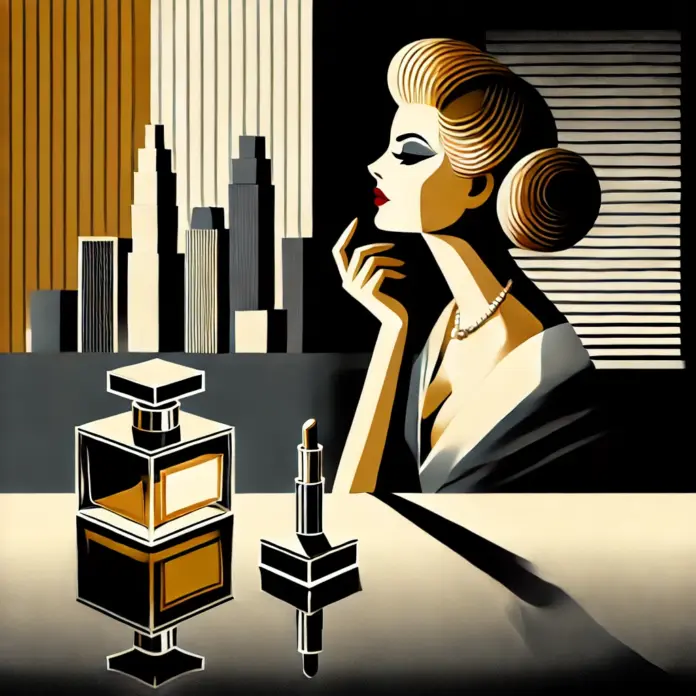
She arrived in New York the way legends do — not with noise, but with presence. A small woman wrapped in confidence and pearls, stepping onto Fifth Avenue as though she were inspecting a stage built for her alone. The city was loud, hungry, rough around the edges, but Helena Rubinstein moved through it with the poise of someone who understood one simple truth: power is never given; it’s constructed — layer by layer, like cream on a perfectly kept vanity.
Long before The Empresario would celebrate titans of industry, Rubinstein was staging her own brand reinvention in a world ruled by men who believed beauty was frivolous. She disagreed. Beauty, to her, was currency — subtle, intoxicating, and capable of reshaping a woman’s identity from the surface inward. In the cramped rooms of her earliest salons, she learned a secret she never said out loud: if you control the mirror, you control the story.
Estée Lauder — The Scent of Becoming
Her journey began far from these glittering skyscrapers — in the cold winds of Kraków, then the bright, untamed streets of Australia, where a young Helena sold jars of cream as if they contained destiny. What she lacked in resources, she replaced with conviction. Every jar carried not just a formula, but a promise: you could change your life one touch at a time.
By the time she reached London, then Paris, then Manhattan, Rubinstein had sharpened herself into an instrument of ambition. Her salons looked less like businesses and more like sanctuaries — lacquered rooms lit with warm lamps, mirrors angled just so, velvet curtains muffling the sound of the outside world. Women entered as wives or debutantes; they left as protagonists.
The industry saw a beautician. Helena saw an empire.
In an era when advertising was still learning to seduce, she mastered the art. She understood women with a clarity that made men uneasy. She priced her products high, not out of greed, but strategy. If luxury was the language of power, then her jars would speak fluently. Her rivals laughed — until society women began whispering her name with reverence, as if Rubinstein had bottled confidence itself.
But every empire has a mirror, and every mirror has a shadow.
At the height of her success, she faced an unexpected rival: Elizabeth Arden. Two women, two visions, two empires — separated by only a few blocks of Manhattan, united by a rivalry so intense it felt operatic. Arden waged war with pastel packaging and soft glamour; Rubinstein countered with science, structure, and the sharpened edges of sophistication. They never met. They never spoke. They didn’t have to. Their products carried the conversation.
Behind closed doors, Rubinstein wrestled with the solitude of command. Power, she discovered, could be a cold companion. Nights stretched late in penthouses overlooking the city’s glowing spine, where she stood in silk robes, studying her reflection the way a strategist studies a battlefield. Her face — disciplined, impeccable, unyielding — betrayed none of her fears. Would the world accept a woman who didn’t apologize for ambition? Or would it demand softness she no longer had the patience to offer?
Her revelation came not in victory, but in vulnerability. She realized that her brand was not merely about beauty — it was about armor. Her creams didn’t just soften skin; they reshaped identity. A Rubinstein woman wasn’t delicate. She was deliberate.
And so was Helena.
The turning point arrived in Paris, during one of her meticulous product demonstrations. A socialite asked what made Rubinstein’s formulas so rare. Helena paused, uncapped a jar, and let the fragrance rise — subtle, elegant, designed to linger like a private confidence. “It’s not the ingredients,” she whispered. “It’s the intention.”
That line would echo through her empire for decades. It became the quiet thesis of her life — the notion that beauty was not decoration but transformation. To touch the face was to touch the future.
Her legacy stretched far beyond salons and creams. She changed how the world viewed women with ambition, how it viewed beauty as a force of identity, how it viewed branding not as packaging but as personality. She understood brand reinvention instinctively: the woman, the product, the story — all reflections of each other in a perfectly polished mirror.
And so the legend of Helena Rubinstein endures, not because she sold beauty, but because she sold a new definition of it — one forged from intellect, discipline, and unapologetic desire. She taught the world that elegance could have an edge, that power could be worn like lipstick, that reinvention was not a luxury but a responsibility.
Late in life, as she walked through her Manhattan penthouse — walls adorned with modern art, each piece chosen with the same precision she applied to her formulas — she paused at a window overlooking the city. The skyline glittered like a spread of diamonds spilled across black velvet. She touched the glass lightly, as though testing the temperature of a world she’d reshaped with her own hands.
In the reflection, she saw two women: the immigrant girl who had crossed oceans, and the empire-builder who had conquered them. Between them, a single truth shimmered.
Beauty is not what you see.
It’s what you become.