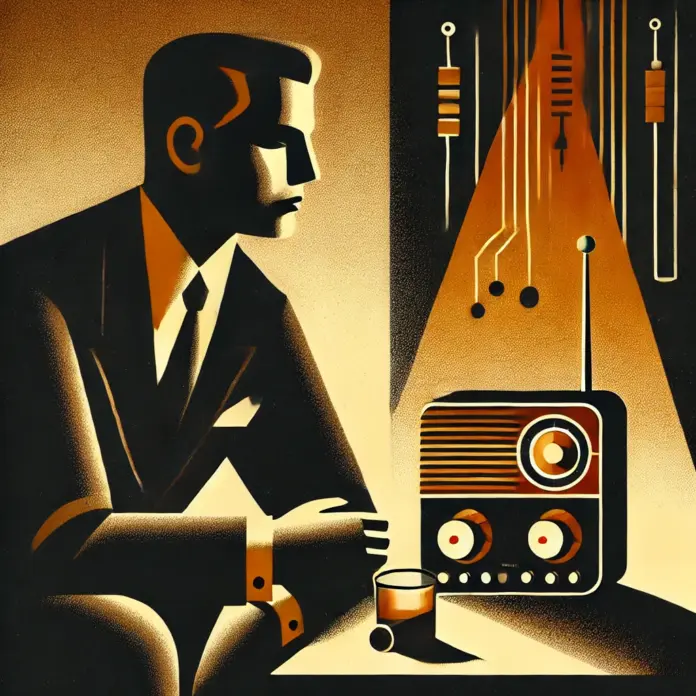
The war was over, but Tokyo still whispered in shades of gray. Smoke drifted through the narrow streets like the city was exhaling its last memory of ruin. In a cramped, drafty room above a bombed-out department store, Masaru Ibuka sat beside a table of scavenged tubes and wires, listening to the soft, stubborn hum of a homemade radio. It wasn’t much — a pulse, a flicker, a fragile signal clawing its way through static — but to him, it sounded like tomorrow.
Ibuka was a quiet man, the kind who let ideas speak louder than ego. He carried himself with the discipline of a soldier who had lost interest in fighting and discovered the seduction of rebuilding instead. While businessmen pored over recovery plans and politicians debated policy, Ibuka sat with soldering iron in hand, shaping possibility out of scrap metal. The world had been reduced, humbled, stripped to its bones. And in that stillness, he found opportunity.
The corporal who once repaired radios now dreamed of shrinking them — not just in size, but in meaning. Radios that belonged not to governments or armies, but to people. Radios that could travel with them, become companions to their hopes rather than reminders of their fears. It was a radical thought in a country that barely had enough electricity to keep the lights on. But every empire begins as an unreasonable idea.
In those early days, when the windows rattled from nearby construction and the city smelled of dust and wet cement, Ibuka worked as if he were restoring the soul of a nation. Wealth didn’t interest him. Recognition didn’t distract him. What he wanted was purity: the clean, precise click of innovation in motion. He believed that technology should feel like magic, delivered without explanation — an extension of the human spirit, not a decoration of it.
His partner, Akio Morita, was the storyteller; Ibuka was the instrument maker. Morita could charm a banker. Ibuka could charm a circuit. Together, they formed a strange and beautiful symmetry — ambition and restraint, vision and craftsmanship. If Morita built the stage, Ibuka tuned the lights, adjusted the sound, and ensured the illusion felt real.
Yet every genius carries a shadow, and Ibuka’s was the silence. He worried the world would never care about the delicate beauty of what he built. That his creations would be swallowed by the noise of American giants or dismissed by a world that had decided Japan was a nation of followers, not leaders. But the quiet ones have a way of bending history without raising their voice.
His turning point arrived not in the form of applause, but in a challenge — a device so small and unassuming it looked like a toy. The transistor. He saw in it what others missed: the chance to rewrite the scale of technology, to personalize the experience of sound. It was the key to brand reinvention before anyone dared say the words. Sony would not merely make electronics; it would make intimacy. It would make the future portable.
The day the first transistor radio came to life, Ibuka didn’t cheer. He simply closed his eyes and listened. Beneath the static was a frequency only he could hear — a signal from the future calling him forward. Japan would rise again, not through force, but through innovation. Through details. Through elegance. Through discipline honed to a razor’s edge.
As the company grew, the myth of Ibuka grew with it. Executives whispered about his ability to sense flaws before a product touched the shelf, to hear inefficiency in the soft click of a dial, to feel imbalance in the weight of a device without ever lifting it. They said he could look through a prototype like it was glass. But Masaru Ibuka didn’t care for myths. He cared for precision. He cared for the people who would hold his inventions in their hands and feel — for the first time — that technology was personal.
At night, he would stand at the window of Sony’s modest office, watching Tokyo’s lights flicker back to life, one bulb at a time. The skyline was not a monument yet. It was a promise. A whispered reassurance that progress, like sound, travels farther than you think.
In moments like these, he allowed himself a rare indulgence: reflection. He thought about how the world would remember him — if it would remember him at all. Engineers are often the invisible ones, their work seen but not their faces, their brilliance folded neatly into the fabric of everyday life. But Ibuka didn’t build for fame. He built because he believed a nation could be healed by wonder. And wonder, he knew, began with listening.
Every Empresario learns eventually that power isn’t always loud. Sometimes it arrives in a whisper — a faint signal beneath the noise, waiting for someone patient enough to hear it. Masaru Ibuka heard it long before the rest of the world tuned in.
Sony would go on to become a global force, reshaping music, film, gaming, culture itself. And yet, at the heart of it all was a man with solder on his fingertips and a quiet conviction that the world could be reinvented through elegance and detail. He didn’t build products. He built possibilities. He crafted a new identity for a rising nation and, in doing so, perfected the art of brand reinvention without ever speaking the phrase out loud.
In the end, Ibuka’s true legacy wasn’t innovation. It was intimacy — the way he made technology feel like a companion instead of a machine. He taught the world to listen again. Not to the noise, but to the signal buried beneath it.
And if you listen closely, you can still hear it today:
the soft hum of the future, tuning itself to a quiet genius who refused to raise his voice.