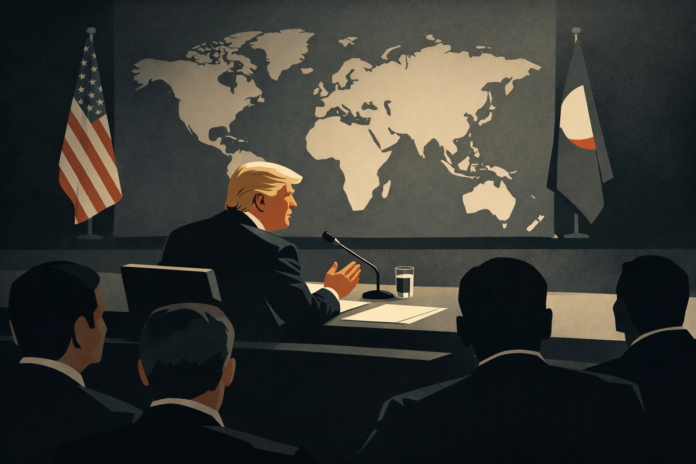
When Donald Trump stepped onto the stage at the World Economic Forum in Davos this week, it was clear that this was not a ceremonial stop on a diplomatic circuit. This was leadership as performance and negotiation under observation, with consequences rippling across policies, markets, and alliances. For days, delegates and executives had watched Washington’s largest delegation in years take shape, an unusually large constellation of cabinet officials and aides accompanying the U.S. president to the Swiss Alps. Organizers noted the scale of the American presence well before the forum formally began, signaling that the United States intended more than a routine address at the 56th annual meeting.
Trump’s opening address to the forum on January 21 was anchored in what he framed as America’s economic success and strategic clarity. He presented an “America First” economic growth model built on lower taxes, higher tariffs, expanded energy production, and tighter immigration and trade policy—policies he argued were producing measurable results at home and posed an alternative to prevailing global norms. In the packed Congress Hall, he took aim at Europe’s economic direction and described a reticence toward green energy and migration as obstacles to investment and growth.
That speech was not without friction. Trump’s effort to elevate Greenland’s status as strategically vital to U.S. interests triggered swift rebuttals. He advocated “immediate negotiations” for a U.S. role in Greenland’s future, insisting he would not use force while nevertheless positioning the territory as critical to global security and missile defense planning. European leaders made clear that Greenland’s sovereignty was not open to negotiation, and his comments—coupled with repeated misstatements about geography—became a focal point for international press and fact checks alike.
The week’s tension was not confined to rhetoric. Trump also announced the establishment of a new multilateral body called the Board of Peace, unveiling its founding charter during a Davos signing ceremony attended by representatives of roughly nineteen countries. The initiative, presented as a vehicle for advancing ceasefire and reconstruction efforts in Gaza, was pitched as a possible complement to—or eventual rival for—the United Nations, even as several traditional U.S. allies declined to participate.
Observers interpreted the Board of Peace’s launch as the strategic deployment of a diplomatic instrument designed to assert American leadership on conflict resolution on terms defined in Washington. In the room and beyond, executives and foreign ministers tracked not only the content of Trump’s remarks but the persona of unvarnished authority he brought to them. Some embraced the initiative; others signaled discomfort at its exclusion of key Western European partners.
The United States’ posture shaped the forum’s broader debates. Global policymakers emphasized resilience in growth during panel discussions, insisting that trade and cooperation would endure despite disruptions from U.S. trade policy and geopolitical friction. Leaders from the International Monetary Fund and the World Trade Organization noted that global trade continued to flow under existing frameworks, even as the noise around American moves rippled through markets and capitals.
That tension crystallized in private corridors as well as public sessions. Trump’s threats earlier in the week to impose tariffs on countries backing measures to defend Greenland against U.S. pressures—and his subsequent partial retreat—illustrated the dual nature of his leadership: assertive maneuvering paired with rapid adjustment when markets and allies signaled risk. The pullback on tariffs stabilized financial markets after initial jolts, and NATO leadership emphasized solidarity even as disagreements persisted.
Critics and allies responded in real time. French President Emmanuel Macron and other European leaders openly criticized what they described as a drift toward unilateralism and “a world without rules,” spotlighting the deeper dilemma confronting global governance institutions when a major power reframes its role on its own terms.
Through it all, executives and delegates were engaged not just with policy pronouncements but with the patterns those pronouncements signaled. Corporate chairs and investors recalibrated expectations about trade flows, regulatory certainty, and alliance cohesion. Governments weighed whether to deepen cooperation in areas like infrastructure and technology while hedge planning for less predictable political backdrops.
In this context, leadership manifested less as consensus building and more as boundary setting. Trump used Davos to assert a version of American authority that did not seek approval from the room but rather compelled others to adjust. The Board of Peace’s launch, Greenland’s diplomatic discord, and market reactions all underscored that the United States was asserting itself as a standard unto itself, expecting others to interpret their strategies in light of Washington’s positions rather than the reverse.
When the forum wound down, no single declaration resolved tensions or unified perspectives. What emerged was a clearer picture of leadership practiced at the intersection of domestic objectives and global reaction. Trump’s role this week was not merely to present a narrative of U.S. exceptionalism or economic supremacy but to operationalize it in a forum designed for convergence. Whether that strategy fosters long-term cooperation or greater fragmentation remains an open calculation. What is certain is that this year’s Davos will be revisited not as a meeting of agreement but as a moment when leadership was asserted through disruption and adaptation, a moment that will shape how executives and governments plan for the year ahead.